
White, yellow or rose gold: which gold to choose?
6 October 2026
Yellow gold carries the warmth of a classic style. White gold provides a brighter, cooler frame and sets off diamonds particularly well. Rose gold introduces a gentler, pinkish hue and a completely different character. But when choosing jewellery you want to wear for years, colour is only the first thing you notice. White, yellow and rose gold differ according to their alloy composition, the metals that
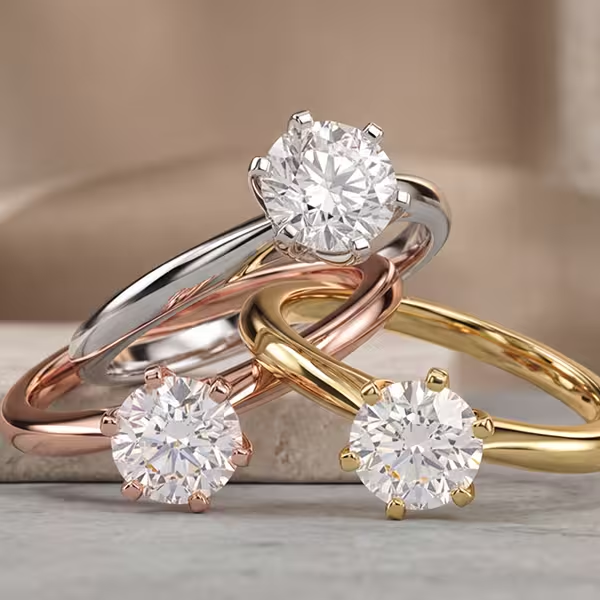
Yellow gold carries the warmth of a classic style. White gold provides a brighter, cooler frame and sets off diamonds particularly well. Rose gold introduces a gentler, pinkish hue and a completely different character.
But when choosing jewellery you want to wear for years, colour is only the first thing you notice.
White, yellow and rose gold differ according to their alloy composition, the metals that are combined with pure gold to achieve the desired colour and the appropriate properties of the material.
Therefore, the choice is not just a matter of which shade you like best. The fineness of the gold, the alloy composition, the design and construction of the piece, the way the jewellery will be worn, the finishing, and, for jewellery set with diamonds and gemstones, the relationship between the metal and the stone are all important.
At Zlatara Andrejević, where knowledge of gold and jewellery making has been developed and passed down through more than eight decades of family tradition, the choice of gold colour is viewed in precisely this way: as a blend of materials, design, style of wear and personal flair.
Therefore, to the question “which gold is the best?”, there is no single answer.
There is gold that is the right choice for a specific piece, and for the person who will wear it.
Why can gold be yellow, white or rose?
Pure gold is naturally an intense yellow colour and very soft. To gain the properties required for jewellery making, it is combined with other metals.
This is how gold alloys are created.
The type and ratio of the added metals affect the colour and certain properties of the alloy. That is why a gold ring, necklace or earrings can have a yellow, white or rose hue, even though all three cases feature gold jewellery.
Here it is important to distinguish between two concepts:
the colour of gold refers to the appearance and composition of the alloy, while the fineness of gold indicates the proportion of pure gold in that alloy.
In other words, white gold is not “less golden” because it is not yellow.
Two pieces of different colours can have the same fineness of gold, while their character will be determined by the alloy composition, the finishing, and the way they are designed and crafted.
What is yellow gold?
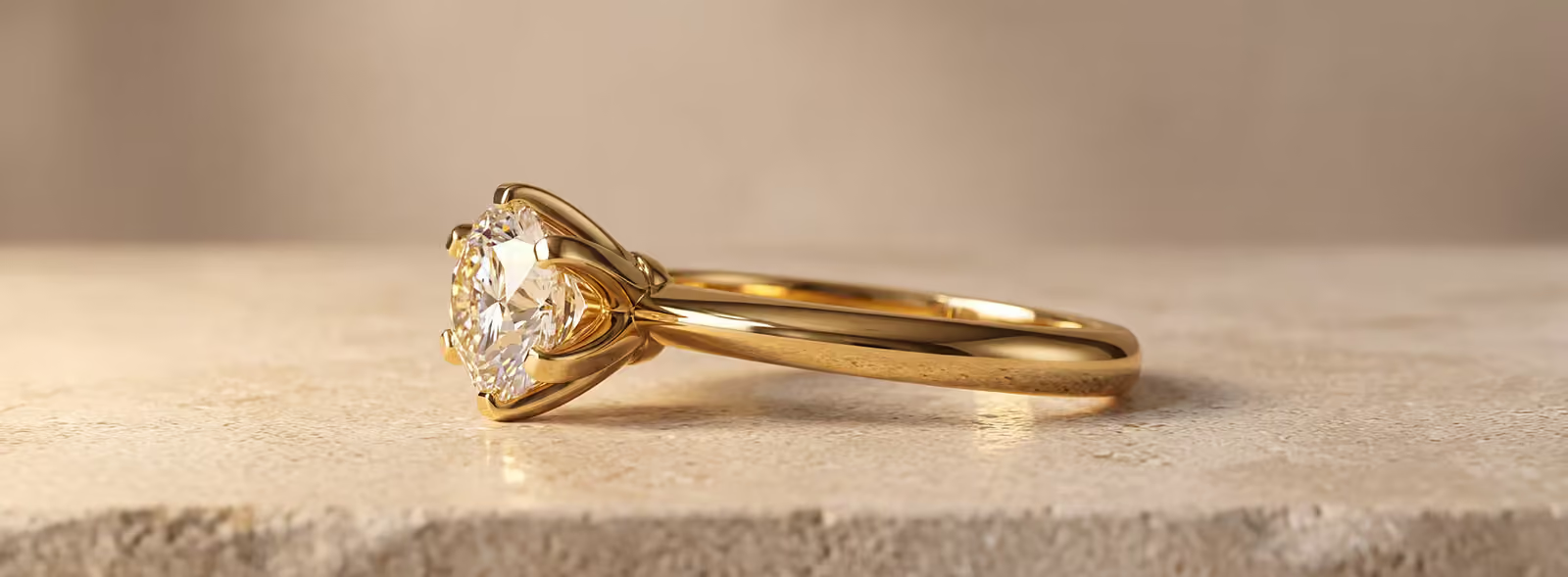
Yellow gold is a gold alloy that retains the distinctive warm, golden-yellow colour of the precious metal.
This is the shade that most people intuitively associate with gold, and for that very reason, it has a timeless character.
But “classic” does not necessarily mean traditional.
Yellow gold can express itself in a completely different way in a substantial ring, a delicate minimalist necklace, geometric earrings or a contemporary bracelet.
It works particularly well with the warm tones of gemstones, while paired with a colourless diamond, it creates a striking contrast between the warmth of the metal and the light of the stone.
Who suits yellow gold?
Yellow gold is often associated with warm and neutral skin undertones, but skin tone should not be the rule by which you choose a valuable piece of jewellery.
What you already spontaneously wear speaks far louder.
If you have chosen yellow gold for years, if it naturally fits with your wardrobe and other pieces of jewellery, and if you recognise yourself in it, that is more important than any theory about skin undertones.
Jewellery should look natural on the person wearing it, not like the result of a rule they have read.
What is white gold?
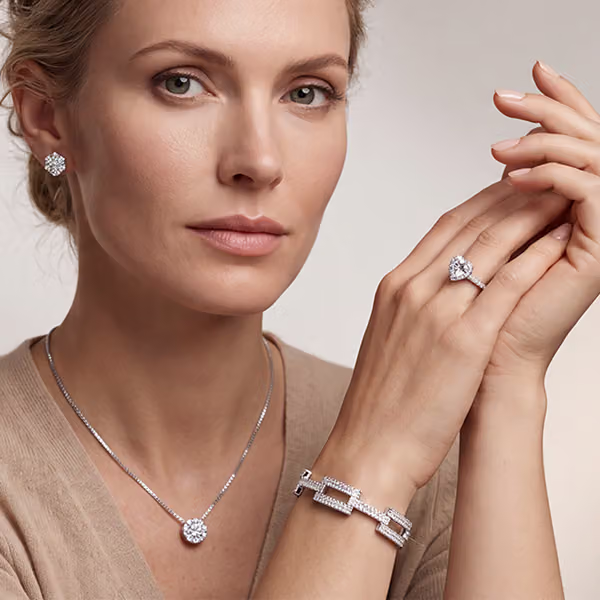
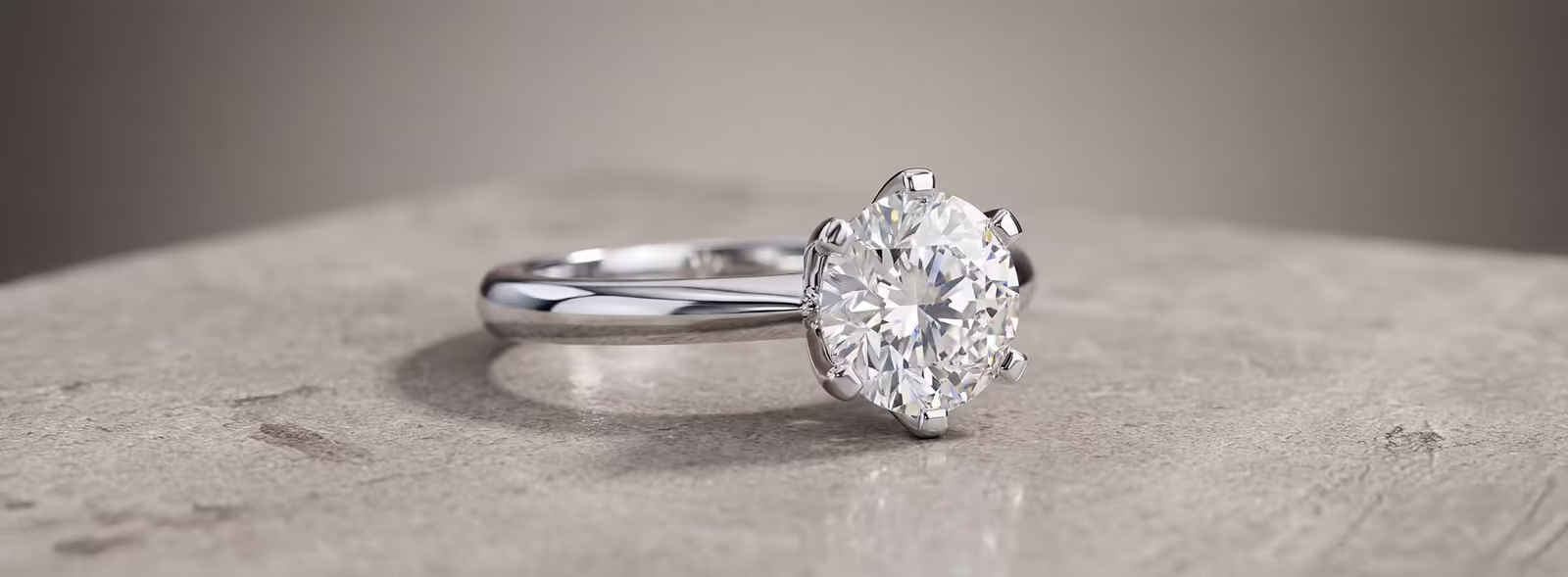
White gold is a gold alloy combined with metals that give its naturally yellow colour a brighter, cooler appearance.
With many white-gold pieces, the final appearance is further enhanced by rhodium plating, applying a thin layer of rhodium that gives the surface its characteristic brightness and shine.
It is precisely because of its neutral character that white gold easily complements different styles, but it holds a special place in Andrejević diamond jewellery.
The reason is not merely a trend.
With bright diamonds, white gold visually connects with the stone and provides a very clean setting for its brilliance. For this reason, it is a frequent choice for diamond and engagement rings, earrings, necklaces and other pieces where the diamond is the central element.
Does white gold change its appearance over time?
Yes, the surface appearance of rhodium-plated white gold can change over time. This in itself does not mean there is anything wrong with the jewellery.
The rhodium layer wears away gradually during wear, and the rate depends on the type of piece, frequency of wear, contact with other surfaces, cosmetics and chemicals.
The change is therefore usually visible sooner on a ring worn daily than on earrings, which have significantly less physical contact with the surroundings.
When necessary, a jeweller can assess the surface condition and restore its characteristic appearance through professional maintenance and re-rhodium plating.
It is therefore important to distinguish dirt from a change in the finish. More intense home cleaning will not restore a worn rhodium layer.
Read more about how to properly care for different types of jewellery in the guide How to clean and maintain gold jewellery at home.
What is rose gold?
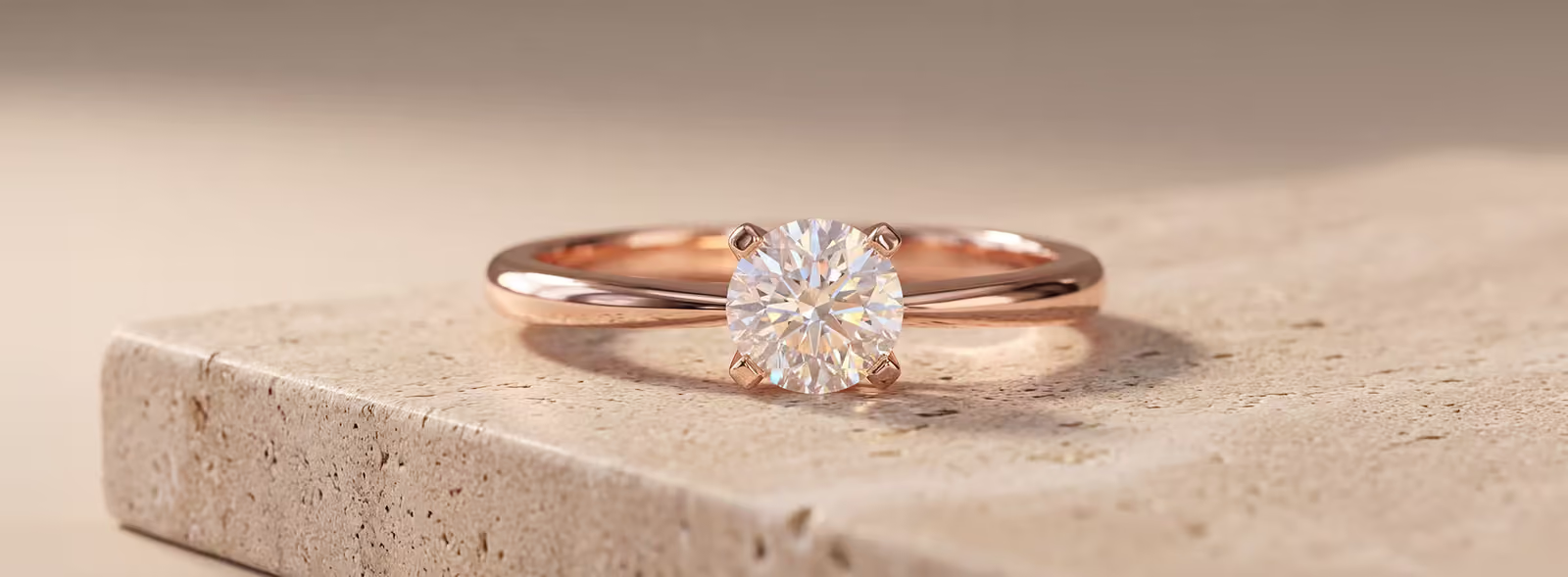
Rose gold is a gold alloy recognisable by its warm pink hue, achieved through a specific alloy composition with a significant influence of copper.
Depending on the ratio of metals in the alloy, the shade can be very delicate or more pronounced.
Rose gold therefore has a different visual character from traditional yellow gold and more neutral white gold.
It can appear soft and romantic, but that is not its only interpretation. In a clean, geometric design, rose gold can look very contemporary.
A particularly interesting relationship occurs with a colourless diamond: the warmth of the metal and the light of the stone create a contrast that highlights both elements.
What is the main difference between white, yellow and rose gold?
Put simply:
Yellow gold retains a warm, recognisable colour that is closest to gold's natural appearance.
White gold has a brighter and cooler character and is particularly frequently used with diamonds.
Rose gold has a warm pink hue significantly influenced by the copper in the alloy's composition.
If the fineness is the same, it is not a matter of one colour being "real" and another "less real" gold.
The difference lies in the alloy composition, colour, specific material properties and finish.
That is precisely why the colour of gold should not be viewed separately from the piece being made.
Is white gold more expensive than yellow gold?
The colour of gold alone is not enough to determine the price of jewellery.
The value of a specific piece is influenced by the fineness and weight of the gold, the composition and complexity of craftsmanship, the design, finish, amount of handwork and, when present, diamonds or other gemstones and their characteristics.
With white gold, certain additional stages of finishing may also be part of the crafting and maintenance process.
Therefore, two rings of the same colour can have very different values, just as a white-gold ring does not automatically have to be more expensive than the corresponding yellow-gold model.
The value of fine jewellery is determined by the whole, not the colour of the metal viewed in isolation.
White, yellow or rose gold for diamonds?
All three colours can be an excellent choice. What changes is the way we perceive the stone.
White gold gives a bright diamond a neutral frame. The metal visually recedes, whilst attention remains on the light and brilliance of the stone.
Yellow gold creates a more pronounced contrast. The warmth of the metal remains visible alongside a bright diamond and can yield both a classic and a very contemporary result, depending on the design.
Rose gold also creates a contrast, but its overall impression is softer and warmer.
With diamond jewellery, there is another reason why the colour of gold should be viewed expertly: the metal, setting design and characteristics of the diamond together influence the final visual effect.
That is why when choosing a valuable diamond piece, one does not simply select the "most beautiful gold colour". The relationship between metal, stone, design and the way the jewellery will be worn is considered.
You can explore more models in the Andrejević diamond jewellery collection.
Which gold colour is best for a ring?
With Andrejević gold rings, the colour comes to the fore in particular because a ring is constantly in view and often worn alongside other rings.
Yellow gold brings warmth and a recognisable character. White gold appears brighter and more neutral, complementing diamonds particularly well. Rose gold introduces a different, warm shade to a collection.
If you already wear a wedding band or an engagement ring, consider their colour as well.
A new ring can complement them or create an intentional contrast.
However, with pieces that will be worn together daily, colour is not the only important factor. Attention should also be paid to the profile and construction of the rings and how they physically touch during wear.
Which gold colour to choose for earrings?
With Andrejević gold earrings, the colour of the metal sits right next to the face, so it can have a very noticeable effect.
Yellow gold brings warmth. White gold provides a clean, neutral frame and works particularly well alongside diamonds. Rose gold adds a softer shade.
Hair and skin tone can serve as guidelines, but it is much more important how the earrings work with the jewellery you already wear and your personal style.
The best pair is not the one that according to some rule "matches your skin tone".
It is the pair you reach for even when you are not thinking about what you should wear.
Which gold colour to choose for a necklace?
A necklace takes centre stage between the face and clothing, so the colour of gold can be particularly prominent.
A simple yellow-gold chain brings warmth. White gold can become an almost neutral base for a diamond or another stone, whilst rose gold provides a subtle colour even without an additional element.
If you wear multiple necklaces at once, they do not all have to be the same gold colour.
Repeating a single shade in several places can tie a combination together, but mixing metals can be just as elegant when it looks intentional.
Explore various models of Andrejević gold necklaces.
Which gold colour to choose for a bracelet?
With Andrejević gold bracelets, it is useful to look at the watch, rings and other bracelets you already wear as well.
If you prefer a calmer, more uniform look, you can stick to a single metal colour.
If you prefer more contemporary combinations, yellow, white and rose gold can be worn together.
With bracelets, practicality should also be considered: pieces move around and touch one another during the day, so alongside colour, their proportions and construction need to be taken into account.
And what about gold pendants?
With a pendant, the colour of the gold should be considered alongside the chain.
If you want the two elements to visually feel like a single piece, using the same gold colour is the simplest solution.
However, that is not the only option.
Different colours can be an intentional design choice, particularly when the same shade is repeated on another piece of jewellery.
Even more important than colour is ensuring that the chain's proportions and construction suit the pendant.
You can find various models in the collection of Andrejević gold pendants.
Can yellow and white gold be worn together?
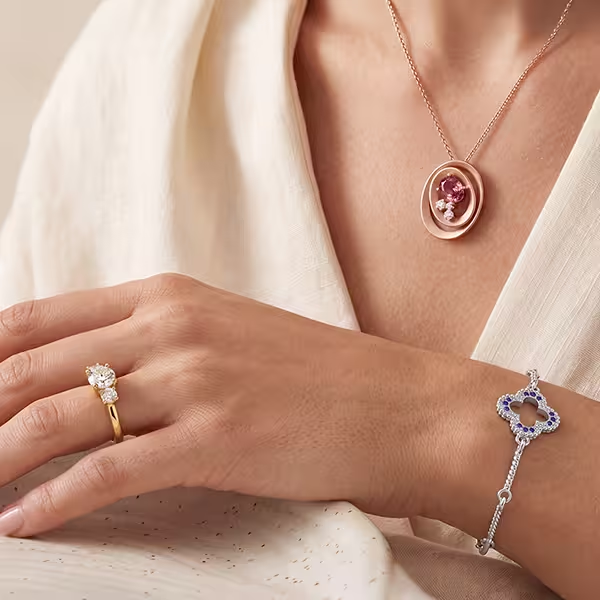
Yes. Yellow, white and rose gold can be worn together.
The idea that all jewellery must be in a single metal colour is no longer the only way to style pieces.
A yellow-gold wedding band can be worn alongside a white-gold ring. Several bracelets can combine different shades. Necklaces can be layered without requiring every chain to be the same colour.
If you want the combination to look more cohesive, repeat the second metal colour in another place.
There are also pieces that combine two or three gold colours within a single design, naturally unifying the rest of your collection.
Read more about this in our guide How to combine gold jewellery: necklaces, earrings, bracelets and rings.
How to choose a gold colour based on skin tone?
You will often read a simple rule: warmer skin undertones suit yellow and rose gold, cooler undertones suit white gold, whilst neutral undertones suit various colours.
This can serve as an interesting starting point.
However, it is not a strict rule by which valuable jewellery should be purchased.
Hair colour, wardrobe, existing jewellery, the design of the specific piece and your personal feeling are equally important, often even more so.
If you try two rings on your hand and one immediately feels as though it belongs to you, the answer is often already there.
Which gold colour is the most fashionable?
Trends change. Fine jewellery lasts much longer.
Yellow, white and rose gold are not colours that exist for just one season. Their presence in fashion may fluctuate, but each holds a firm place in contemporary jewellery design.
That is why, for a more valuable piece, we would not base a decision primarily on the question “What is being worn right now?”
A much better question is:
“What will I want to wear in ten years' time?”
Timelessness does not mean jewellery has to be conservative.
It means it should have a reason to stay.
How to care for white, yellow and rose gold?
Regardless of colour, fine gold jewellery should be protected from unnecessary contact with harsh chemicals, impacts and abrasive surfaces.
Cosmetics, perfumes and cleaning products can leave residue or affect the surface finish. When you are not wearing your jewellery, it is good practice to store pieces separately to minimise friction and scratching.
For white gold, the surface finish should also be taken into account. If a piece is rhodium-plated, professional refinishing may be required over time.
For jewellery set with diamonds and gemstones, care methods should be tailored not only to the gold, but also to the type of stone, any treatment it may have received, and how it is set.
Therefore, with fine jewellery, it is not always advisable to attempt to resolve every change in appearance at home.
You will find a detailed guide in the article How to clean and care for gold jewellery at home.
How does a jeweller's expertise affect the choice of gold colour?
Colour is chosen by eye. However, a quality decision requires an understanding of what lies behind it.
At Zlatara Andrejević, knowledge of gold and jewellery crafting has been passed down through generations of the Andrejević family for over eight decades. Today, that tradition brings together master craftsmanship, design, gemmology, and expertise in diamonds and gemstones.
This matters because gold is not just about colour.
A jeweller considers the alloy, construction, and crafting technique of the specific piece. A designer observes the relationship between metal colour, form, and stone. A gemmologist understands the characteristics of the diamond or gemstone that the metal will support.
In diamond jewellery, this expertise is particularly evident. Kosta Andrejević is a master craftsman of exclusive jewellery, designer, and certified diamond specialist; Andreja Andrejević is a certified gemmologist and specialist in master diamond setting; whilst Aleksandar Andrejević is a certified gemmologist and jewellery designer.
That is why expert advice should not tell you that white, yellow or rose gold is “the best”.
It should help you understand why a particular alloy, colour and design better suit the specific piece you are choosing and how you plan to wear it.
So: white, yellow or rose gold?
If you are drawn to the warmth and signature character of gold, a yellow hue may be a natural choice.
If you prefer a brighter, cooler look and a metal that discreetly complements bright diamonds, consider white gold.
If a warm rosy tone and a slightly distinctive character suit you, rose gold may be precisely what you are looking for.
However, there is no colour that is universally superior.
There is only the one you will want to wear.
And perhaps that is one of the finest qualities of gold: the same precious metal can take on a completely different character, yet remain truly timeless.
In the Andrejević gold jewellery collection, you can explore different gold colours through rings, earrings, necklaces, bracelets and pendants.
Frequently asked questions about white, yellow and rose gold
Is white gold real gold?
Yes. White gold is an alloy of gold and other metals that give it a brighter appearance and specific properties. Its fineness indicates the proportion of pure gold in the exact same way as with yellow or rose gold.
What is the difference between white and yellow gold?
The key difference lies in the composition of the alloy, which affects both its colour and finished appearance. Yellow gold retains its signature warm hue, whilst white gold has a brighter, cooler character.
What gives rose gold its pinkish colour?
The distinctive shade of rose gold is significantly influenced by copper in the alloy mixture. The exact tone depends on the specific proportion of metals used.
Does white gold turn yellow?
White gold is not naturally fully white. With rhodium-plated jewellery, as the surface layer wears down over time, the base shade of the alloy may become more visible. When necessary, professional maintenance and re-rhodium plating can restore the surface appearance.
Which gold is best with a diamond?
There is no single best colour. White gold gives a colourless diamond a more neutral frame, while yellow and rose gold create a more pronounced contrast. The choice depends on the characteristics of the stone, the design and the desired look of the piece.
Can I combine white and yellow gold?
Yes. Different colours of gold can be worn together, and there are also pieces that combine two or more shades within a single design.
Does the colour of gold affect its fineness?
Not necessarily. Colour and fineness are different characteristics. Fineness indicates the proportion of pure gold in the alloy, whilst colour depends on the alloy composition and any final finish.
Which colour of gold is best for everyday wear?
The colour itself is not decisive. Important factors include fineness and alloy composition, construction of the piece, the surface finish, any gemstones, and how you intend to wear the jewellery.
Is rose gold less valuable than yellow gold?
Not simply because of its colour. The value of a specific piece depends on the fineness and weight of the gold, the craftsmanship, the design, and any diamonds or gemstones, rather than whether the alloy is yellow, white, or rose in colour.