
Men's wedding bands: modern or classic style
30 June 2026
Why a man's wedding band deserves its own decision
When couples select wedding bands, conversations often center on the woman's ring, its combination with the engagement ring, stone choices, and matching width. The man's wedding band is frequently treated as 'the same model, just wider', a decision made in five minutes based on her choice.
However, men's wedding bands offer a world of options worth careful consideration. Profile, finish, width, and metal combinations all determine whether a men's wedding band appears classic, modern, or somewhere in between. Crucially, these choices impact comfort for 24-hour daily wear across all lifestyle activities.
This guide covers everything you need to know before deciding, from fundamental style choices to practical considerations often overlooked at the jeweller's.
Classic or modern: the key style decision
Before considering width, profile, and finish, it is worth addressing the key style choice: whether the men's wedding band should be classic or modern.
A classic style of men's wedding band implies a narrower to medium width (4-5 mm), high shine, a simple flat or subtle court profile, and most commonly yellow or white gold without additional design elements. The most famous representative of this style is court-profile wedding bands, a model frequently requested in our jewellery store by that exact name. They are characterised by plain craftsmanship without ornaments, a subtly rounded court profile, and a high shine. It is a wedding band that does not draw immediate attention, yet feels solid, dignified, and timeless. This style never ages; a band bought twenty years ago looks identical to new models of the same type. An added bonus is that the size is easy to adjust if needed.
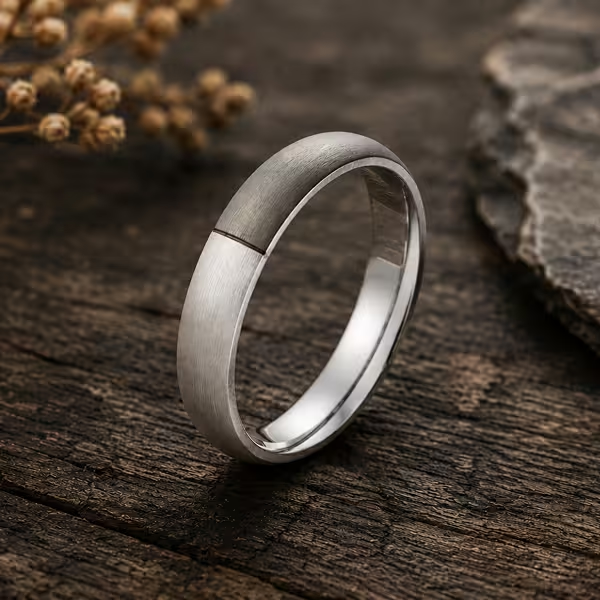
A modern style opens up far more options: wider bands (5-7 mm), combinations of finishes (matte and polished together), mixed metals, geometric elements, and potential exterior engravings as part of the design. A modern men's wedding band serves as a statement, an expression of personal style, and not merely a symbol.
Most men instinctively know which style they lean towards before even visiting the jeweller's; the only question is whether they are ready to trust that instinct. A classic choice is always safe. A modern choice is bolder, but when well selected, it yields a wedding band that truly belongs to the wearer, rather than conforming to a generic idea of a "men's wedding band".
If the women's wedding band is chosen to complement the engagement ring, select one of the mentioned ways to match the men's band to the pair. For more details on matching, see the guide on how to match a wedding band with an engagement ring.
Width: more than just a number of millimetres
The width of a men's wedding band is a decision that visually dominates all other choices. The difference between a 4 mm and a 6 mm band is dramatic, not only in how it looks on the hand, but also in what it conveys.
4 mm, subtly classic The narrowest standard choice for a men's wedding band. It feels minimalist, almost weightless on the hand, and pairs effortlessly with everyday wear. An excellent option for men who do not want a band that "shouts" or attracts attention, but who desire a quality traditional ring. It works particularly well on slimmer hands or when matching a very fine women's wedding band.
5 mm, a balanced classic The most popular men's wedding band width at Zlatara Andrejević. Substantial enough to feel like a true men's band, yet subtle enough not to overpower the hand. It suits almost every hand profile and nearly all styles. A dependable choice when a couple is undecided.
6 mm, a distinct presence A 6 mm band makes a clear impression on the hand. It feels robust, solid, and present. It looks particularly well-proportioned on larger hands. It is often chosen when a more pronounced presence is desired, especially when combined with a specific finish or a combination of metals. For most hand profiles, this represents the upper limit of a "comfortable" width.
7 mm and wider, a statement The widest options, which serve as a clear design statement. These suit larger, more robust hands, best worn by someone whose personal style allows them to carry off such a band with ease. This is not a choice for someone seeking a neutral look; it is a conscious statement.
The trend in recent years has leaned towards slightly wider men's wedding bands than was traditionally common. While the classic 4 mm width retains its audience, 5 mm and 6 mm have become the standard for most couples.

Profile: the most vital decision for comfort
If a man works with his hands, uses them extensively throughout the day, or plays sports, the band profile can be more important than any aesthetic choice.
Flat profile: Classic, traditional, and visually most prominent. Both the outer and inner surfaces of the band are flat, giving the ring a distinctive "block" character. An aesthetically safe choice, though it may prove less comfortable, as the flat inner edges can occasionally cause mild discomfort during active work.
D-profile (classic rounded) The outer surface is rounded (D-shaped in cross-section), while the inner surface is flat. The most traditional European wedding band profile, both classic and more comfortable than a completely flat one. A good default choice.
Comfort-fit profile (court profile): Both the outer and inner surfaces are gently rounded. The most comfortable for 24-hour daily wear, as there are no sharp inner edges to irritate the skin, allowing the ring to slide smoothly over the finger even during physical activity. Visually, it presents a slightly softer contour than the D-shape profile.
Practical tip: if a man works in healthcare (surgeons, dentists), kitchens, manual trades, or plays sports, a comfort-fit, court profile is almost always worth choosing. The difference in daily comfort is significant, while the aesthetic difference compared to a D-shape profile is minimal. For office work and a classic lifestyle, a D-shape profile is entirely sufficient.
Finish: where classic and modern diverge
The surface finish of a wedding band is the element that most clearly distinguishes classic from modern styles, often more than the metal or width itself.
High polish is the traditional finish. The band reflects light evenly, offering a characteristic shine that is instantly recognizable. An aesthetically safe and timeless choice. Minor daily surface scratches are less noticeable because a reflective surface can be easily repolished.
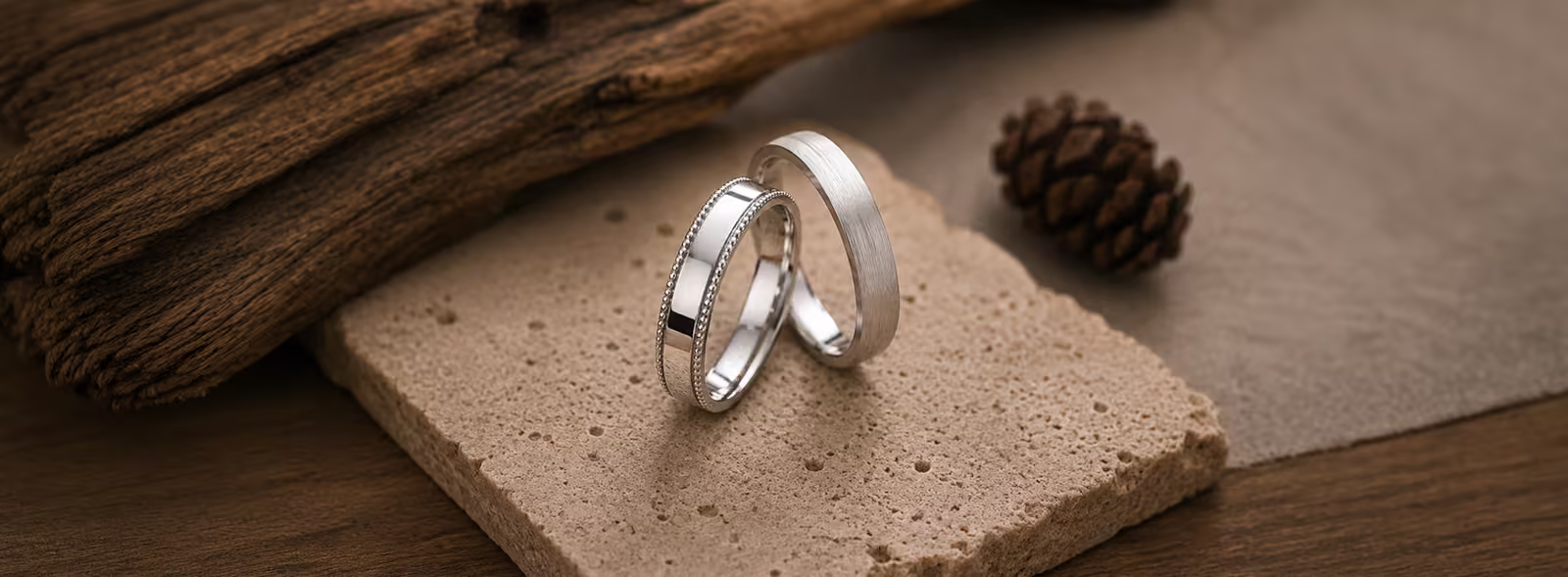
Matte finish (satin or brushed) features a subtly textured, smooth surface without reflection. It appears more modern, subtle, and refined. One practical advantage is that minor daily scratches are less visible than on a polished surface, helping the band retain a fresh look for longer. Over time, a matte finish may develop a slight sheen from natural wear and friction, giving the band a unique, distinguished character.
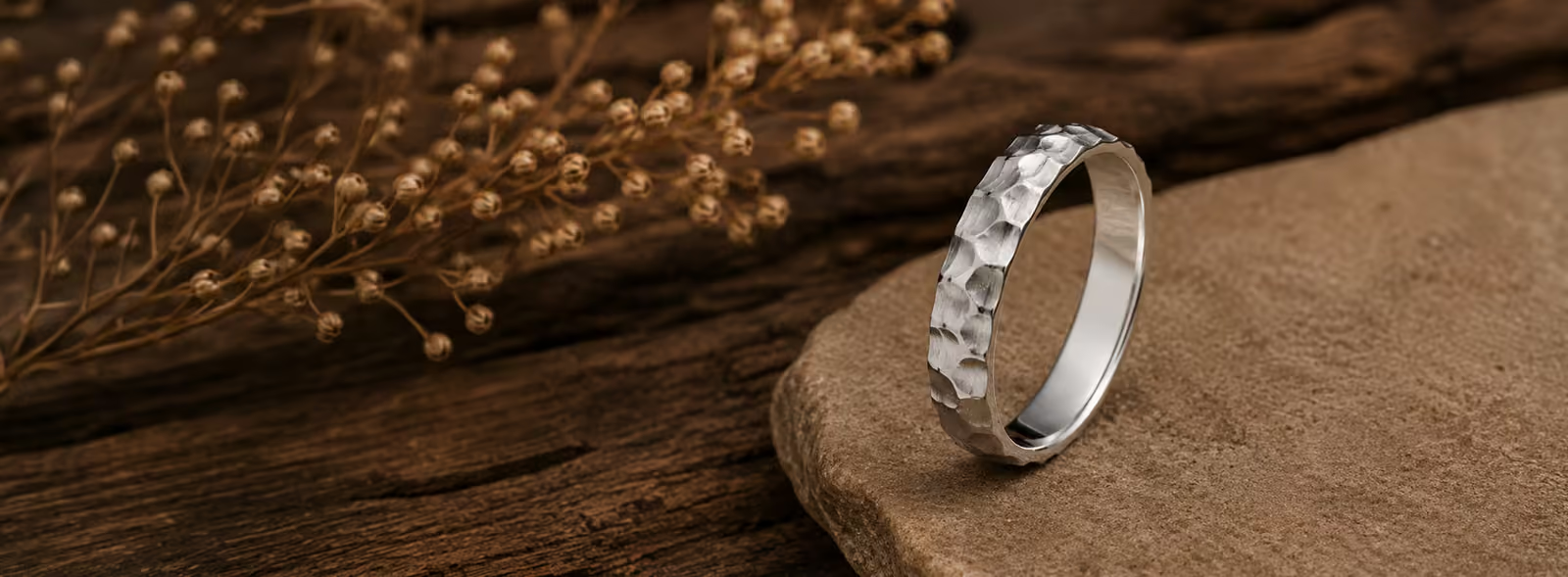
Sandblasted is a texture featuring fine surface indentations, giving the band a distinctive, tactile character. It is the most modern finish, often chosen for men's wedding bands designed to feel robust and contemporary rather than purely traditional.
Milgrain edge is a technique where the border of the band is embellished with fine, precise beads, imparting a classic vintage character. It is frequently combined with a high-polish central band, offering refined detail without being overpowering.
Combined finishes have become increasingly popular in recent years: a band may feature a central matte band with polished edges, or vice versa. These designs add visual interest without the need for additional gemstones or engravings.
Metal colour: more choices for men's wedding bands
Although yellow gold is the traditional choice for a men's wedding band, other tones and combinations are increasingly popular today. We discussed in detail how the choice of metal alters the overall impression of a ring in our guide: yellow, white or rose gold: how metal colour changes everything.
Specific recommendations for men's wedding bands include:
Yellow gold, a classic choice that never ages. It feels warm, dignified, and traditional. The safest selection for men seeking a timeless ring.
White gold, a modern tone offering a refined look. It pairs easily with other accessories, such as watches, silver, or platinum chains. A practical detail to keep in mind: the rhodium coating gradually wears over time, so the band will benefit from re-rhodium plating every 3 to 5 years.
Rose gold, the least traditional choice for a men's wedding band, yet an increasingly popular choice for couples seeking a unique look.
Platinum wedding bands, crafted from the most durable metal that does not wear away over time. It offers a subtly softer sheen than rhodium-plated white gold, with a prized platinum lustre. Its higher price point is the primary reason it is chosen less frequently.
Metal combinations, white and yellow, rose and white, or all three tones combined in a single band. These models are an excellent choice when partners wish to tie their bands to different metal tones they already wear, or when seeking a distinctive design without stones.
Diamonds in men's wedding bands: a matter of personal preference
While a diamond in a men's wedding band was once an exception, it is widely embraced today, though it remains a matter of individual style and preference.
When a diamond makes sense:
- Personal style already includes everyday jewellery (watches, chains, rings)
- The partner's engagement ring is elaborate, making a pavé or channel-set band a balanced pairing for the couple
- A man explicitly desires a diamond as part of the ring's design, which is a stylish and valid choice
When a diamond may not be the right choice:
- Personal style is strictly minimalist, as diamonds always add a noticeable visual element
- Daily activities involve heavy manual work, carrying a risk of stone damage
- The band is being purchased purely out of tradition, rather than from a genuine desire for a diamond
Settings that work best for a men's wedding band:
Channel setting is by far the most popular choice. The stones are set flush within the metal itself, keeping the surface smooth and reducing the risk of dislodgement. The visual effect is subtle yet striking.
Bezel setting (a sleek metal rim around the diamond) functions as a discreet detail. A single stone, set centrally or along the side profile, provides character without feeling overly ornate.
We have covered all diamond setting options for wedding bands in detail in our guide on how to choose a diamond wedding band, containing everything you need to know. If you would like to explore a broader selection, view our diamond wedding bands at Zlatara Andrejević.
Practical recommendations based on lifestyle
Lifestyle often dictates practical decisions more than aesthetic preferences. Here are some of the most common profiles and recommendations that usually work best:
Active lifestyle (sports, physical work, heavy use of hands): court profile, matte or sandblasted finish, medium width (5 mm), no stones or channel setting. The goal is a wedding band that "survives" everything life throws at it, with minimal maintenance.
Office style (intellectual work, formal wear): D-profile, high polish, classic width (4–5 mm), yellow gold, white gold or platinum. A wedding band that looks good with a suit and doesn't demand attention.
Creative/designer style (architects, designers, creative professionals): freedom to go in unconventional directions, mixed metals, diamond accents, unusual finishes, asymmetrical designs. A wedding band as an expression of personality.
Classic traditional style Yellow gold, high polish, classic width (5 mm), D-profile, no stones. A wedding band following a timeless aesthetic.
These are not rules, but starting points; every person is a combination of all these elements, so the final choice should always reflect the individual wearing the wedding band.
Should a men's wedding band match the women's?
The traditional approach is for the couple to have matching wedding bands: the same metal, a similar profile, a connected design. The only differences are in dimensions (the men's is usually wider) and any stones (often only the women's features diamonds).
The modern approach allows more freedom. Different metal tones (white gold for her, yellow gold for him), different finishes, or even completely different styles can work, provided there is some connection that makes the pair a pair.
The best connection is usually the same metal or a combination of the same metals. Everything else (width, profile, finish, stones) can vary. This allows each partner to have a wedding band that truly suits them, while the couple still looks coordinated.
We wrote in more detail about matching wedding bands in a pair and with an engagement ring in the article how to match a wedding band with an engagement ring.
Renowned brands for men's wedding bands
At Zlatara Andrejević you will find a wide selection of men's wedding bands from the Andrejević family workshop, as well as carefully selected models from world-renowned brands specialising in wedding bands.
Breuning is a German brand with decades of tradition, known for precise craftsmanship and contemporary men's models. Their collection ranges from the simplest classic wedding bands to models featuring mixed metals and design details that make a men's wedding band special.
Saint Maurice is a European brand with a strong range of men's wedding bands. Models with textural variations (matte, sandblasted, bevelled edges) that lend character without additional stones are especially appreciated.
Frequently asked questions about men's wedding bands
What is the best width for a men's wedding band?
The most popular widths are between 5 and 6 mm, prominent enough to feel substantial, yet classic enough not to look experimental. The final choice depends on hand size and personal style. A safer choice for an average male hand is 5 mm; for larger hands or a bolder style, 6 mm.
Should a men's wedding band be made of the same metal as the women's?
Traditionally yes, but it is not a rule. The most important thing is for the pair to have some visual connection; the same metal is the safest way, but the same design style or metal combination in both rings also works. We explain the matching rules in more detail in our guide on matching wedding bands with an engagement ring.
How do we know which profile is the most comfortable?
The best way is to try them on. At Zlatara Andrejević we have different profiles available to try in all three metal tones; often, simply putting two versions on the same finger (D-profile and court profile) makes the difference clear. For men who use their hands intensively, a court profile is almost always a better long-term choice.
Does a matte finish have less shine in the light?
Yes, a matte finish reflects light diffusely, whilst high polish reflects it directly. Visually, matte feels softer, which is an advantage if you are looking for a subtle, modern appearance. The difference is best appreciated in person, as photographs rarely convey the true distinction.
Can a men's wedding band be engraved on the outside as part of the design?
Yes, this is an increasingly popular option. Engraving on the outer surface of a wedding band can be a discreet pattern, a geometric element, specific text (coordinates, a date, a short word), or even a fingerprint. It differs from traditional inside engraving, which is intimate and personal. You should consider whether you want a design feature that is publicly visible every day, as it is a permanent decision.
How much does a quality men's wedding band cost?
Prices span a wide range, starting from around 80.000–100.000 RSD for classic 14k gold bands without stones, up to 300.000–400.000 RSD for 18k gold or platinum pieces. Complex designs and diamonds can increase the price further. Usually, it is the weight of the metal that influences the cost the most.
Visit Zlatara Andrejević and try them on in store
A men's wedding band is not chosen from photographs; it is chosen in person, by trying on different widths, profiles and finishes to see how they look and feel on the hand. The difference between a classic D-shape and a court profile becomes clear only when the ring is placed on your finger. The difference between a matte and polished finish cannot be conveyed through a screen. Our team at Zlatara Andrejević will guide you through all options without pressure, with the same care the Andrejević family has poured into crafting jewellery for over eighty years.
View our main wedding bands page to browse the complete collection, or explore specific categories by metal: yellow-gold wedding bands, white-gold wedding bands, rose-gold wedding bands, platinum wedding bands, and diamond wedding bands. Find our store locations and book an appointment at a time that suits you.