
How to match a wedding band with an engagement ring: a complete guide
19 June 2026
When two rings are worn together for a lifetime
An engagement ring and a wedding band are the only pair of jewellery worn together every day for a lifetime. This means that matching them is not merely a question of style; it is something that will be looked at thousands of times, under different lights, on various occasions, and over decades. A combination that looks good at first glance in the jeweller's must look just as good ten years later.
The good news is that matching wedding bands and engagement rings does not have to be complicated. There are a few principles that always hold true, a few situations where you can freely break the rules, and a few mistakes worth avoiding. This guide walks you through everything, from the basics of metal colour to specific combinations with solitaire, halo, and vintage designs.
Why matching wedding bands and engagement rings is important
An engagement ring and a wedding band are most often worn on the same hand, next to each other. This means they are seen as a single whole, rather than two separate rings. When two rings are not matched, the hand looks "divided", as if the rings belong to different people.
Matching does not mean being completely identical, which is perhaps the biggest misconception. The best combinations are those where two rings have different characters but a shared language: the same palette of metals, a similar finish, proportional dimensions. The difference between "identical" and "matched" is essential: identical looks a bit robotic, while matched looks deliberate.
Rule number 1: metal colour
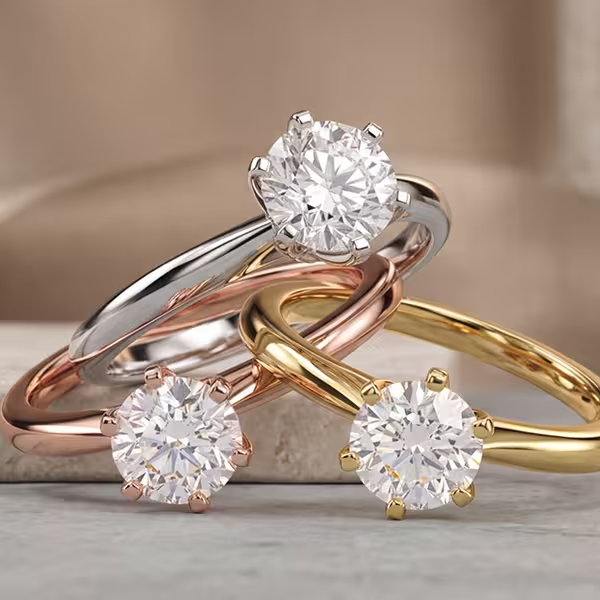
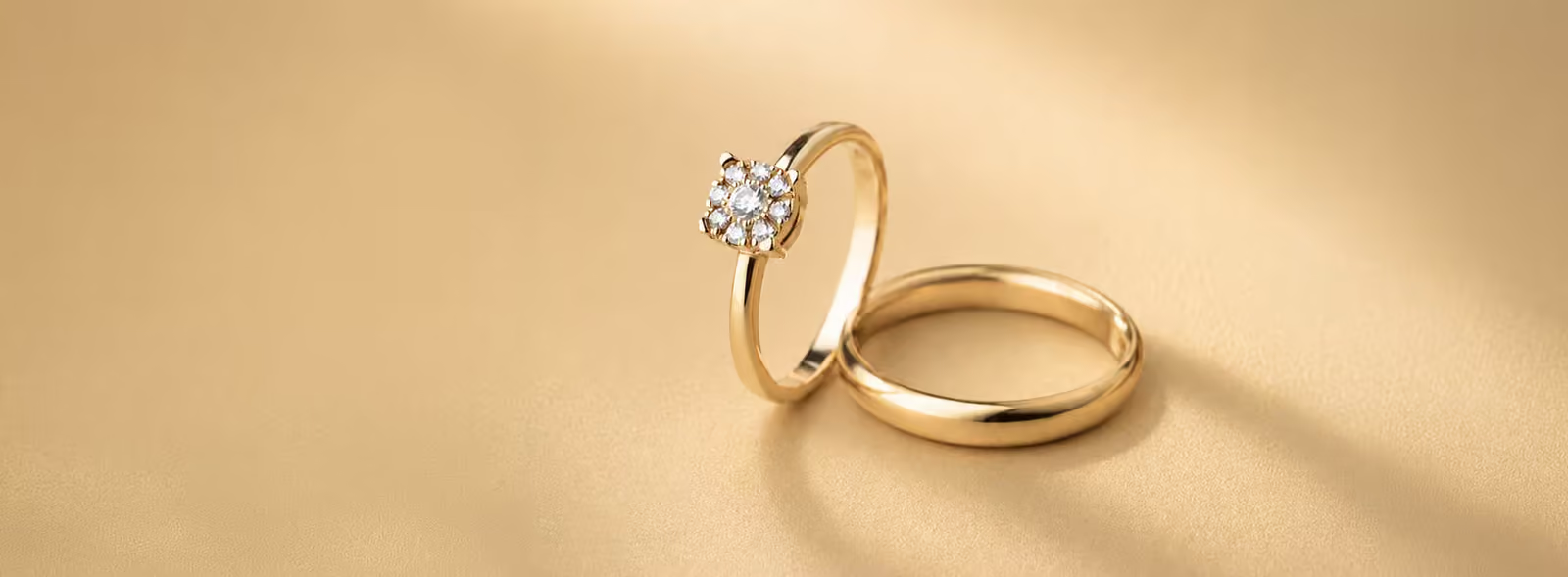
This is by far the most important principle. The wedding band usually follows the metal tone of the engagement ring. If the engagement ring is white gold, a white gold wedding band looks most natural. If the engagement ring is yellow gold, yellow gold is the safer choice.
The reason is simple: two rings of different tones on the same hand create a visual conflict that the eye struggles to accept as a "whole". Combining metals is permitted, but requires a careful approach. It is most successful when the engagement ring itself is a combination of metals (e.g. rose and white gold), allowing the wedding band to complement either tone more freely.
Practical advice: If you are just choosing an engagement ring and know you want matched wedding bands, consider which gold tone feels most natural to you in daily life. White gold is versatile and easy to combine, rose gold adds character, while yellow gold is a timeless classic. We explain how metal colour changes the overall impression of jewellery in detail in our guide to wedding band colours.
Rule number 2: width and proportions
The second most important principle is the relationship between the width of the wedding band and the engagement ring.
If the engagement ring is more substantial, featuring a larger central diamond, a halo design, or a wide band: a classic narrower wedding band (2–3 mm) remains in the background, letting the engagement ring take centre stage. This is a traditional, safe choice.
If the engagement ring is understated, such as a solitaire with a smaller stone or a simple band: the wedding band can be wider (3–4 mm) and take on part of the visual role. A wider wedding band compensates for a more understated engagement ring, keeping the hand balanced.
Recent trends lean towards slightly wider women's wedding bands than traditional ones. The classic 2 mm band is increasingly giving way to 3 to 4 mm bands, which offer a more pronounced presence without stealing the limelight from the engagement ring. For men's wedding bands, the range is broader, from 4 to 7 mm, matching the style and size of the hand. We wrote more about choosing men's wedding bands, profiles, and finishes suited to different styles in our article men's wedding bands: classic or modern style.
Rule number 3: profile and height
The profile of a wedding band, whether flat, D-profile (rounded on the outside), or court-profile (rounded inside as well), is mostly a matter of comfort, but it also affects appearance when worn alongside an engagement ring.
The most important question regarding profile is whether the wedding band and engagement ring "clash" when worn together. If the engagement ring has a high setting (high-set solitaire), a classic flat-profile wedding band often cannot sit flush against it, leaving a gap or sitting at an angle.
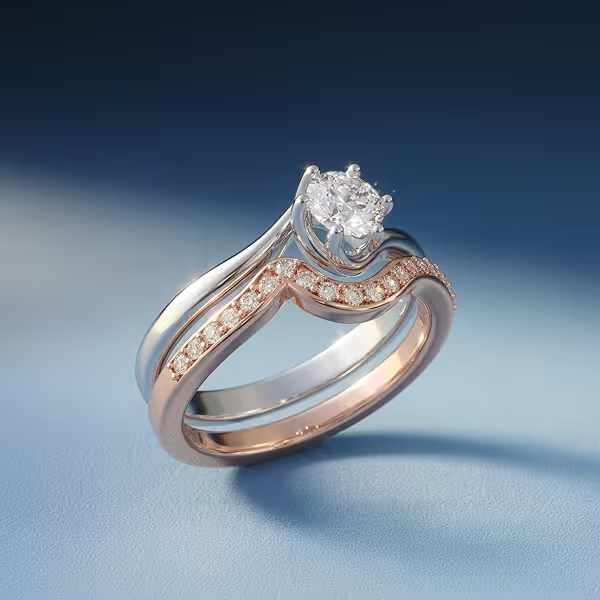
The solution: wedding bands with a contoured profile (shaped wedding bands) that follow the line of the engagement ring. This type of wedding band is tailored to the shape of a specific engagement model and sits perfectly flush against it, without gaps or tilt. It is worth noting that this option should be considered in advance, as a contoured wedding band is crafted specifically for your engagement ring.
For couples who want the wedding band to look good on its own (for occasions when the engagement ring is not worn), a classic flat or D-profile wedding band remains the right choice. It functions beautifully both on its own and next to an engagement ring.
Rule number 4: style and character
A classic engagement ring pairs best with a classic wedding band. A modern, geometric engagement ring suits a more modern wedding band. A vintage engagement ring with filigree details calls for a wedding band that shares that spirit.
This does not mean the wedding band has to be a replica of the engagement ring's style, but it must speak the same design language. Specific examples:
- A solitaire engagement ring with a round brilliant-cut diamond pairs best with a classic, clean wedding band, with or without subtle diamond accents
- A halo engagement ring (a central stone surrounded by a circle of smaller ones) matches splendidly with a pavé wedding band that extends the sparkle
- A vintage engagement ring with milgrain details deserves a wedding band with similar filigree or milgrain elements
- A three-stone diamond engagement ring (trilogy) balances well with an eternity band or a classic wide wedding band
Read more about how to recognise the style and character of an engagement ring in our article engagement ring design: what she would love.
Rule number 5: diamond accents: when to choose them and when to avoid them
The question of whether a wedding band should feature diamonds depends on two things: how striking the engagement ring is and what statement the couple wishes to make.
A plain wedding band is a versatile choice: it always works, is never overwhelming, and pairs effortlessly with any engagement ring. If the engagement ring is already elaborate (halo, trilogy, diamond pavé on the band), a classic plain wedding band creates visual balance.
A diamond wedding band adds extra dimension and works brilliantly in two situations: when the engagement ring is understated (a classic solitaire) and when the couple wants the wedding band to be a statement in its own right. There are several styles: solitaire accent (a single stone in the band), pavé (smaller stones along the band), eternity (diamonds around the entire band), and channel setting (stones set within the metal). Diamond wedding bands are part of a wider collection of diamond jewellery at Zlatara Andrejević, allowing you to add matching pieces later.
We explain how to choose the right balance between classic design and diamond sparkle in detail in our article how to choose a diamond wedding band: everything you need to know. If you are interested in a broader selection of diamond wedding bands, explore our collection.
When wearing rings on different hands is the right choice
There is a practical reality rarely mentioned: some engagement rings and wedding bands simply cannot sit nicely together, regardless of contoured profiles and every effort. A high-set solitaire might sit too high for any wedding band to align flush against it, a designer model with an intricate setting around the stone often leaves no room for a classic wedding band, and a vintage ring with deep engraved detailing can be so distinctive that any wedding band beside it looks out of place.
There is also a technical reason that is often overlooked: wearing two poorly fitting rings together over many years can damage both. Metal rubs against metal, wearing down the outside of the wedding band, while the prongs holding the diamond on a high-set engagement ring can weaken under constant pressure. After ten or fifteen years, this can lead to costly repairs or, in the worst-case scenario, the loss of the central stone.
In such cases, there is a completely legitimate solution that is often overlooked: moving the engagement ring to the other hand after the wedding, while wearing the wedding band on the traditional one. This is neither a compromise nor a 'lack of matching', but a conscious choice that allows both rings to retain their full beauty, without mutual abrasion and visual conflict. Many women also choose to keep their engagement ring for special occasions and wear the wedding band every day; there is no rule stating that both rings must be worn together every single day.
Practical tip: if you have already bought an engagement ring with a very complex or high design, bring it to the jeweller's before deciding on a wedding band. An assessment of what is technically possible and what is not can be given in person within a few minutes. It is better to make a decision in advance than after years of daily rubbing between the two rings.
Specific scenarios: most common combinations
Classic solitaire diamond engagement ring + wedding band
The most classic combination in the history of diamond engagement rings. Optimal choice: a narrower classic wedding band (2-3 mm) in the same metal tone. Without stones or with a discreet solitaire accent. Works every time, without exception.
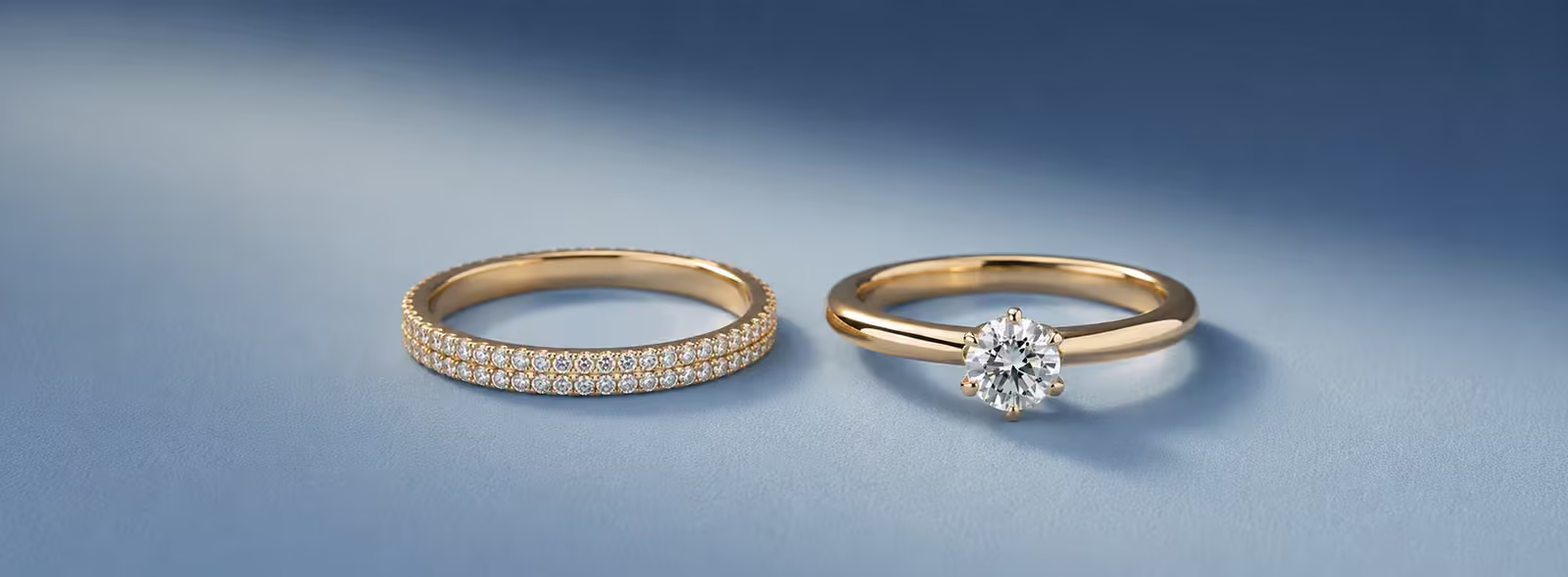
More advanced option: a pavé wedding band in the same tone, with a discreet diamond sparkle that complements the central stone of the engagement ring. A subtle upgrade to the classic combination.
Halo engagement ring + wedding band
A halo design (a central stone surrounded by a wreath of smaller ones) already carries a lot of sparkle, so the wedding band can go in two directions: maximally discreet, a classic wedding band that 'steps back' to let the halo take center stage, or a pavé/eternity wedding band that extends the sparkle.
A contoured wedding band that follows the arc of the halo design is an ideal choice as it sits perfectly without gaps.
Vintage or designer engagement ring + wedding band
Here, a standard wedding band can feel visually 'empty' next to an ornate engagement ring. The best choice is a wedding band featuring the same design language: milgrain details, filigree, engraved patterns. Often, the best option is a bespoke wedding band made to order, ensuring it naturally follows the style of the engagement ring.
Engagement ring with a coloured gemstone (sapphire, emerald, topaz) + wedding band
A coloured gemstone gives an engagement ring a strong character, so the wedding band looks best if it is classic, without stones, in the same metal tone. This allows the coloured stone to remain the sole focus. Alternatively, small diamonds in a pavé setting can work, but avoid coloured stones that might compete with the engagement ring.
When you are free to break the rules
Every principle in this guide is here to help you, not to limit you. There are several situations where you can freely break the rules:
Combining metals, if you truly love the combination of yellow and white gold, embrace it. The trend of mixing metals is growing, especially for couples who want their wedding band to look good alongside other jewellery they already wear. The 'same metal' rule serves as a default, not a law.
Identical wedding bands for both, traditionally, men's and women's wedding bands differ in width and complexity. If you like the idea of wearing completely identical wedding bands, that is a legitimate modern choice. It works particularly well with minimalist classic models.
Wedding band without internal engraving, engraving as a central feature, internal engraving is traditionally a discreet personal touch. However, if you prefer an external engraving as part of the design (a quote, coordinates, a date in block letters, or a fingerprint), it is your personal story.
Practical tips before visiting the jeweller's
Bring your engagement ring with you. The best way to see how a wedding band looks is to try it on in person, on the same hand, next to your engagement ring. Photos rarely convey the true combination.
Try different widths. The difference between 2.5 mm and 3.5 mm sounds small, but it looks dramatic on the hand. Three minutes of trying on rings at the jeweller's brings more clarity than an hour of online browsing.
Consider your work and hobbies. If you work with your hands (doctors, chefs, athletes), a court profile and higher-quality craftsmanship pay off in the long run. A wedding band is worn 24 hours a day, so it should never feel uncomfortable.
Take your time. Wedding bands are best chosen over two or three visits. The first time is to see what is available, the second to compare two or three favourites in person, and the third to make your final decision. Many couples say 'we will come back in two weeks' after their first visit, which is precisely the right approach.
Consider established brands if you want a specific style. Breuning and Saint Maurice are two renowned European brands specializing in wedding bands, offering models ranging from simple classics to designer pieces. Many couples seeking a wedding band with distinctive European heritage find their ideal choice within these collections.
Frequently asked questions
Must a wedding band be made of the same metal as the engagement ring?
It does not have to be, but it is recommended. The wedding band and engagement ring are worn together every day, so differences in metal tone become noticeable over time. The safer choice is the same metal; combinations work best when there is a clear design rationale.
What if the engagement ring and wedding band visually clash?
This is a common issue, especially with high-set engagement rings. The solution lies in contoured wedding bands, specifically designed to follow the line of your engagement ring. It is often worth speaking with your jeweller about this option in advance.
Is it acceptable for the wedding band to be wider than the engagement ring?
Yes, particularly if the engagement ring is understated (such as a simple solitaire). A wider wedding band balances out a delicate engagement ring, creating a harmonious look. Modern women's wedding band trends are leaning strongly in this direction.
When should wedding bands be ordered relative to the engagement ring?
Not necessarily straight away. Many couples purchase the engagement ring months before the proposal, choosing the wedding bands together closer to the wedding date, often 2-3 months prior. Ensuring adequate production time is essential, especially for bespoke contoured bands or imported designs.
Can the men's and women's wedding bands have different widths?
Absolutely, in fact, it is recommended. Men's wedding bands are traditionally wider (4-6 mm), while women's are narrower (2.5-4 mm). What should be harmonised is the style, metal tone, and finish, rather than the dimensions.
Visit Zlatara Andrejević and find your wedding bands
The best way to decide on your wedding bands is to try them on in person, alongside your engagement ring on the same hand, exploring different widths, profiles, and metal tones. At Zlatara Andrejević in Belgrade, our team will guide you through our collection without pressure, providing the same dedication the Andrejević family has offered for over ninety years. Visit our main wedding bands page to view the full collection, or explore specific subcategories: yellow gold wedding bands, white gold wedding bands, rose gold wedding bands and diamond wedding bands. View our store locations and book an appointment at your convenience.