
How to choose a diamond wedding band: everything you need to know
17 June 2026
When a symbol of love gains a symbol of permanence
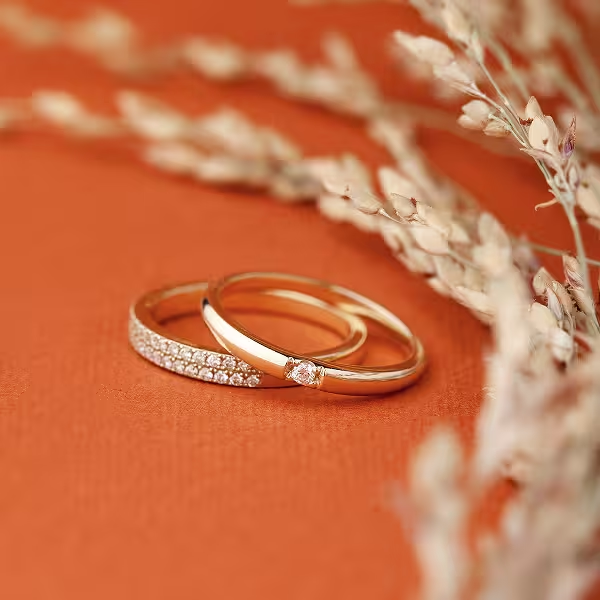
A wedding band is worn for a lifetime, making it quite possibly the longest piece of jewellery to ever remain on one's hands. The diamond, for its part, is the hardest natural material on Earth. Combining the two creates a ring that is not only beautiful, but engineered to endure everything life brings.
More and more couples today choose a diamond wedding band over a classic smooth band. However, the decision is not as simple as a yes-or-no choice: there are several ways a diamond can be incorporated into a wedding band, each altering the look, price, wearability, and durability. This guide takes you through everything worth knowing before making your choice.
Why more couples are opting for a diamond in their wedding band
There are several reasons why diamond wedding bands have ceased to be the exception and have become a popular choice.
First, the symbolism is powerful. Diamond is the hardest natural material, virtually indestructible in daily life, just like the promise a wedding band symbolises. Diamond wedding bands speak of a permanence that goes beyond gold alone.
Second, the aesthetics are subtle. A diamond wedding band does not need to be extravagant or flashy; most models feature subtle stones that lend extra brilliance without looking overcrowded. This is why diamond wedding bands are increasingly chosen by both women and men.
Third, value is retained differently. A diamond wedding band holds more than just sentimental value; it is a material investment that maintains its worth across generations, especially with certified stones.
If you would like a broader overview of all models, the complete collection of diamond wedding bands at Zlatara Andrejević covers all settings and metal tones, from the most discreet single-diamond bands to opulent eternity designs.
When a wedding band "deserves" a diamond, and when it is better without
Before discussing setting styles, it is worth considering when a diamond in a wedding band is the right decision, and when a plain band works better.
A diamond makes sense when:
- The couple wants a wedding band that stands as a statement piece in its own right, not merely as an accompaniment to an engagement ring
- Your lifestyle involves wearing jewellery every day (the wedding band is worn on an evening out, not just at home)
- The budget allows for a high-quality stone; a poor-quality diamond in a wedding band looks worse than a well-crafted classic band
A band without stones is the better choice when:
- Your work involves intensive manual tasks (doctors, surgeons, athletes), fewer stones mean less risk of damage
- The couple prefers a universal, neutral look that does not draw attention
- The budget is limited, a high-quality classic wedding band is better than a cheap diamond one
We have written in more detail about pairing wedding bands with different styles of engagement rings in our guide on how to match a wedding band with an engagement ring, which we recommend reading before making your final decision.
Five essential types of diamond settings in wedding bands
There are five main ways a diamond can be set into a wedding band. Each has its own character, benefits, and considerations.
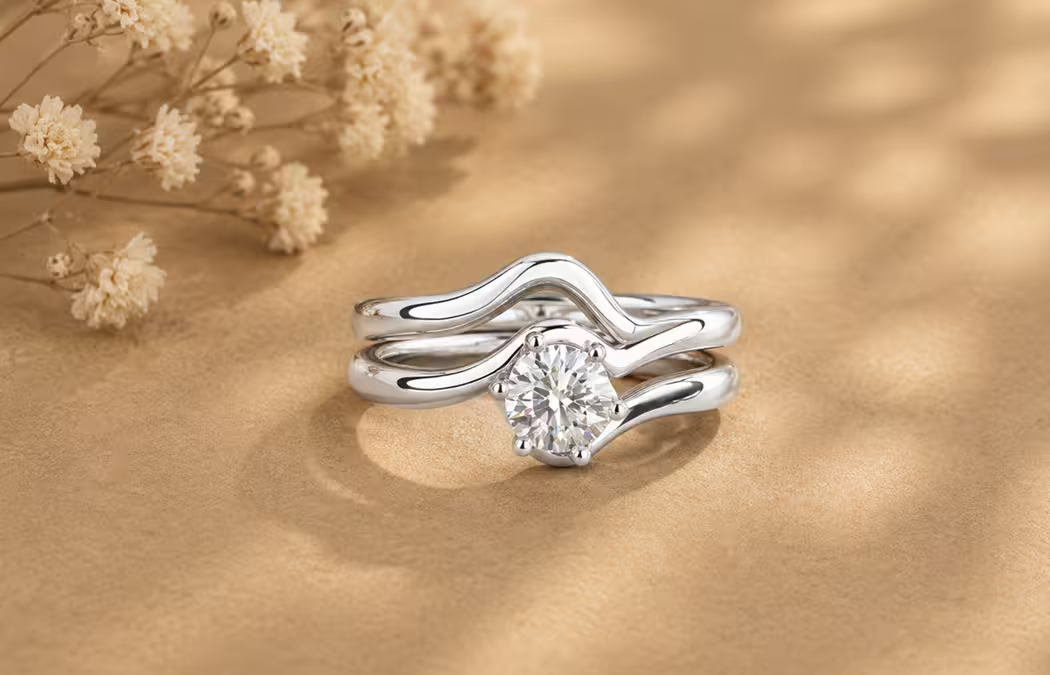
1. Solitaire accent: a single stone, a subtle statement
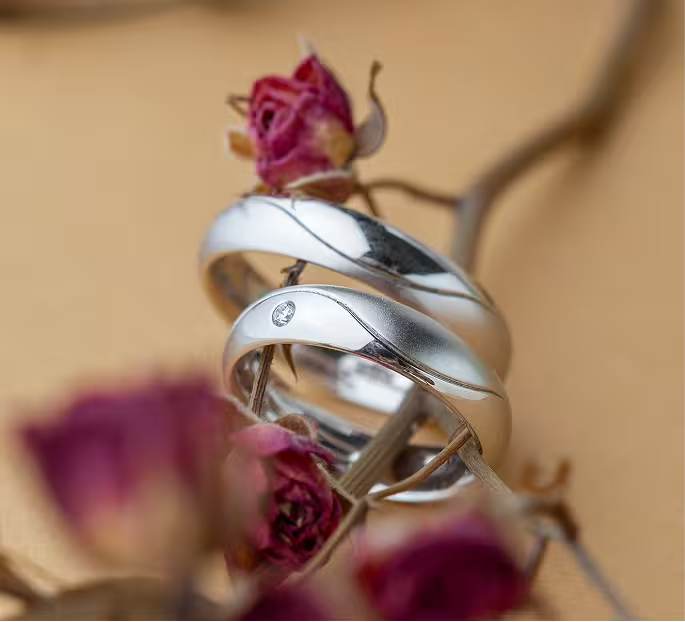
The most discreet option: a wedding band with a single central diamond set flush into the metal itself. Most often placed in the centre of the band, though variations exist with the stone positioned on the side or a few millimetres off-centre.
Benefits: the least conspicuous choice, maximum durability for daily wear, and a lower price than pavé or eternity designs. The sparkle is noticeable, yet the band retains a traditional look. It pairs effortlessly with any engagement ring, including intricate designs.
Considerations: a single stone means quality matters; a low-grade diamond in a solitaire setting is clearly visible. It is worth investing in a good cut and clarity even for smaller stones.
Who it is suitable for: couples seeking a "classic plus" band with an added touch; minimalists who appreciate subtle detail; men considering a diamond accent for the first time.
2. Pavé: continuous sparkle of smaller stones
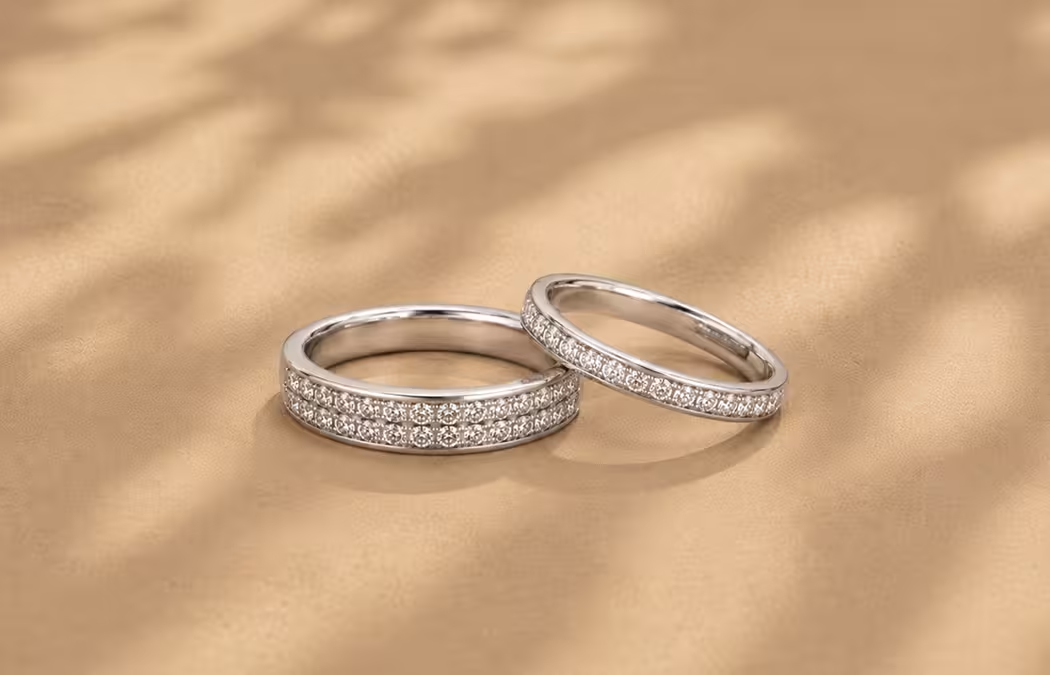
Pavé (from the French for "paved") means the band is paved with smaller diamonds set closely side by side along the shank. Each stone is smaller than a typical solitaire, yet together they create a radiant, continuous sparkle.
Benefits: visually the most lavish effect relative to price; multiple smaller stones of lower carat weight often create a greater impression than a single larger stone. The band catches the light beautifully, especially on evening occasions.
Considerations: pavé setting is technically demanding; the quality of craftsmanship shows in how securely and precisely the stones are aligned. Poor pavé setting means stones can loosen over the years. Our workshop at Zlatara Andrejević crafts pavé settings by hand, drawing on generations of expertise to ensure lasting durability.
Who it is suitable for: couples looking for a striking band; women who want their diamond engagement ring and wedding band to create a harmonious visual look together; lovers of classic elegance unconcerned by price.
3. Eternity: diamonds around the entire band
Eternity (or an eternity wedding band) means stones encircle the entire band, from one side to the other. The symbolism is clear: an unbroken circle of stones represents endless commitment.
Benefits: the strongest symbolism of any option, visually the most striking effect, and an exceptional presence in photographs. An eternity band acts as a statement piece on its own and requires no additional jewellery.
Considerations: eternity designs involve two main trade-offs. First, resizing is more difficult, as stones encircle the entire band, making size adjustments technically complex. Second, the price is higher because the total carat weight often exceeds that of pavé versions.
Half-eternity offers an elegant alternative: stones cover only the visible (top) half of the band, while the lower half remains smooth. This allows for easier resizing and a lower price, with a virtually identical visual effect when worn.
Who it is suitable for: couples seeking maximum symbolism; those who want a wedding band as a standalone piece of jewellery; women whose finger size makes future resizing unlikely.
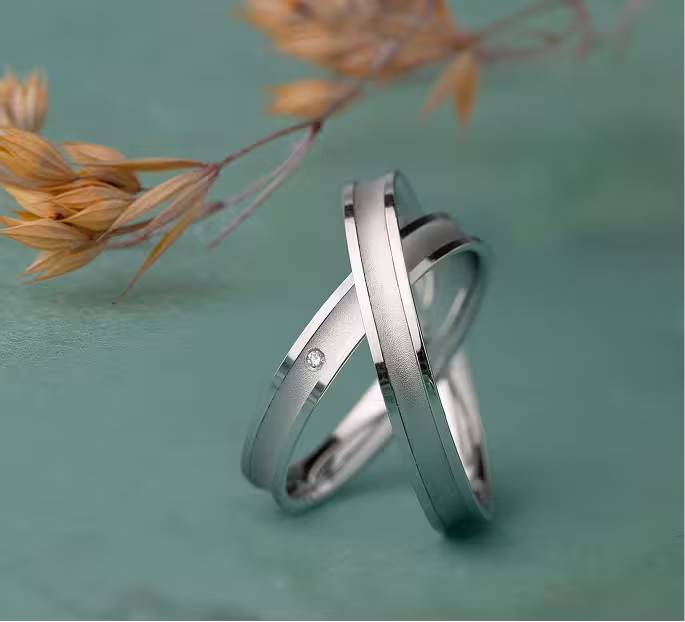
4. Channel setting: stones embedded in the metal
In a channel setting, diamonds are placed within a groove (channel) cut into the metal of the band, so the stones sit slightly recessed. The top of the stones is flush with the metal surface, creating a smooth, uninterrupted finish.
Benefits: exceptional durability for everyday wear. Stones are protected by metal on all sides, virtually eliminating the risk of falling out. The smooth surface will not snag on clothing and is easy to clean. An ideal setting for men's wedding bands as well.
Considerations: the visual effect is more subtle than pavé; the stones sparkle, but less dramatically as the surrounding metal covers their edges. Channel settings often feel more contemporary than traditional pavé.
Who it is suitable for: couples who prefer a modern look over a classic one; lovers of clean, geometric designs.
5. Bezel setting: each stone rimmed in metal
A bezel setting means each individual diamond is surrounded by a thin collar of metal that holds and protects it. This is a more traditional setting style that is well worth considering.
Benefits: maximum protection for each individual stone, a distinctive vintage look, and the ability to securely set a stone of any carat weight.
Considerations: slightly less brilliance, as the surrounding metal absorbs a portion of the light; a visual style that may not suit every preference.
Who it is suitable for: enthusiasts of vintage aesthetics; couples seeking a unique choice outside mainstream trends.
Diamond quality in a wedding band: not always the same as in an engagement ring
There is an important distinction between diamond quality in an engagement ring and in a wedding band. An engagement ring often features a single main centre stone, so every detail of quality (colour, clarity, cut) has a major impact on its appearance. In a wedding band with multiple smaller stones, consistency of cut quality is key.
What this means in practice: for pavé and eternity bands with small stones, a slight compromise on colour (D-F vs G-H) or clarity (VVS vs VS) is often imperceptible to the naked eye. This allows you to achieve more sparkle and a higher total carat weight for the same budget through a modest adjustment in individual stone grading.
However, there is a limit. Before taking this as a rule, it helps to understand the 4Cs of diamond quality, knowing exactly where compromise is sensible and where it is not. A detailed explanation of the 4Cs with specific recommendations can be found in the 4Cs of diamonds, a guide to diamond quality within our educational diamond guide.
Is a certificate necessary for a diamond wedding band?
A diamond certificate, most commonly from GIA, IGI, or HRD, provides legal and technical assurance that the stone matches its description. For engagement rings with a central diamond of 0.20 carats or larger, a certificate is standard practice among reputable jewellers.
With wedding bands, the situation is slightly different:
- In rare cases where a wedding band features a large solitaire stone (0.20 carats or more), a certificate is recommended, just as with an engagement ring
- For wedding bands with pavé, channel, or eternity designs using small stones, individual certificates are impractical; Zlatara Andrejević guarantees quality through its own standards signed by certified GIA gemmologists (typically G/H colour, VVS/VS clarity for fine wedding bands)
We explain more about what GIA, IGI and HRD certificates mean, how to read them, and the difference between them in the article diamond certificates: GIA, IGI or HRD.
At Zlatara Andrejević, all diamonds in our wedding bands undergo an internal GIA-certified quality control, with three Andrejević family graduate gemologists guaranteeing the quality of every stone regardless of whether it has an individual paper certificate.
Natural or lab-grown diamond in a wedding band?
A question that more and more couples are considering. Lab-grown diamonds are chemically, physically and optically identical to natural ones: the only difference is in origin and price. For the same budget you get a larger or higher-quality stone, which is particularly relevant for wedding bands where multiple stones quickly increase the price.
Arguments for a lab-grown diamond in a wedding band:
- Price is 40–70% lower for the same size and quality
- Hardness, brilliance, clarity, everything is identical to a natural diamond
- Resistance to daily wear is identical
Arguments for a natural diamond in a wedding band:
- Investment value: natural diamonds do not decrease in price
- Sentimental value of origin, a stone created millions of years ago
- Tradition: some families insist on natural stones for symbolic reasons
A detailed comparison with all the advantages and differences can be found in the article natural or lab-grown diamond, which to choose. The collection of Luminore lab-grown diamonds at Zlatara Andrejević also includes models for wedding bands, with the same quality control as for natural stones.
Styling combinations: how a wedding band with a diamond pairs with different engagement rings
Combining a diamond wedding band and an engagement ring depends primarily on the character of the engagement ring:
Classic solitaire engagement ring with a central diamond: a pavé wedding band complements it beautifully, as it extends the sparkle of the central stone. Eternity and solitaire accents in the wedding band also pair nicely.
Halo engagement ring: pairs best with a pavé or half-eternity wedding band with more discreet stones. Eternity bands can be contoured to sit flush against the ring. Wedding bands contoured to fit the engagement ring are a very sought-after option today.
Diamond pavé engagement ring (stones along the band): a channel-set wedding band with discreet stones or a pavé band with diamonds along only part of the band balance it best.
Engagement ring with a coloured gemstone (sapphire, emerald, topaz): a classic plain band or a channel-set wedding band with diamonds often looks best. The combination of diamonds in the wedding band and a coloured gemstone in the engagement ring creates a sophisticated contrast.
Vintage or designer engagement ring: a bezel or milgrain diamond wedding band with distinctive details can match the aesthetic of the engagement ring.
Practical details that are often forgotten
Care of diamond wedding bands
Wedding bands with diamonds require slightly more care than classic smooth wedding bands. Smaller stones tend to accumulate dirt between them (soap, cream, dust), so the band loses its shine over time. The solution is simple: a gentle weekly cleaning at home, and ultrasonic cleaning at the jeweller's once every 6 to 12 months fully restores its original lustre. This service is included in customer care at Zlatara Andrejević at no extra cost.
What if a stone falls out?
With quality craftsmanship the risk is minimal, but it can happen, especially with older wedding bands or after a mechanical impact. At Zlatara Andrejević we keep a register of every crafted wedding band and the stones set in it, so if this happens, a stone of identical carat weight and quality is set quickly and seamlessly.
Resizing: here it is important to decide in advance
This is technically the most important practical aspect regarding diamond wedding bands:
- Solitaire accent, half-eternity, channel-set with stones on part of the band: resizing is almost always possible, up to several sizes in either direction
- Pavé with stones around the entire band: resizing is limited, usually up to 1 to 2 sizes only
- Full eternity: resizing is technically the most difficult, but possible with compromises. In some cases, the solution is making a new wedding band
If you are considering a full eternity design, and the person wearing it might expect changes in finger size (pregnancy, aging, weight fluctuations), it is worth considering a version where a small part of the band is left without diamonds. This gives an almost identical visual effect while facilitating resizing if needed.
Frequently asked questions about diamond wedding bands
1. What is the price difference between a solitaire accent and a pavé wedding band?
The difference can be significant; a pavé wedding band with 10 to 20 small diamonds often costs 2 to 3 times more than a band with a single solitaire stone of the same total carat weight. This is because pavé requires many more hours of meticulous handcrafting to precisely set each stone. Prices start from around 150,000 RSD for discreet solitaire accents and go upwards for bands with multiple stones.
2. Can men wear a diamond wedding band?
Yes, a channel setting with discreet diamonds is popular for men's wedding bands. What distinguishes a men's diamond wedding band from a women's is usually the width (5–7 mm instead of 2–4 mm) and the setting type (channel instead of pavé). We wrote in more detail about men's wedding bands in our article men's wedding bands: classic or modern style.
3. Can the wedding band and engagement ring have different diamond settings?
Absolutely; often it is even preferred. Identical settings can look too uniform. An engagement ring with a solitaire diamond and a wedding band with a pavé or channel setting often look best together, as different settings give the hand a visual rhythm.
4. How do we know if pavé setting is done well?
Three things should be checked: 1) Spacing between stones: should be minimal and equal throughout the entire band; 2) Height of stones: all should be level, with no individual stones dipping; 3) Metal details: small metal claws (prongs) holding the stones should be precisely shaped and uniform in appearance. Poor pavé setting is visible even from a distance, as you will notice uneven spacing or a lack of brilliance.
5. Is a lab-grown diamond the "same" as a natural one in a wedding band?
Technically, yes. Chemical composition, physical properties, optical effects are all identical. The only difference is origin (lab-grown develops in controlled conditions over a few weeks, natural over millions of years underground) and price (lab-grown is significantly less expensive). Value retention differs, as natural diamonds generally hold their value better on the secondary market.
6. Is a certificate required for every stone in a pavé wedding band?
No, this is neither practical nor standard. With pavé wedding bands, quality is guaranteed through a general standard applied by the jeweller (e.g. all stones of G-H colour, VVS-VS clarity). It is recommended that such a certificate is signed by a graduate gemologist. An independent laboratory certificate makes sense for single large stones (from 0.20 carats upwards), particularly for solitaire accents. We explain more about what certificates mean and when they are needed in the article diamond certificates: GIA, IGI or HRD.
7. How often should a diamond wedding band be cleaned?
We recommend professional ultrasonic cleaning once a year, as it restores the original brilliance lost over time due to accumulated dirt between the stones. At home, you can occasionally submerge the band in warm water with a little mild liquid soap and gently brush it with a soft toothbrush. Avoid harsh chemicals that could damage the metal or the rhodium plating on white gold.
Renowned brands for diamond wedding bands
Alongside wedding bands from the Andrejević family workshop, our collection features carefully selected models from European houses that specialise in crafting diamond wedding bands.
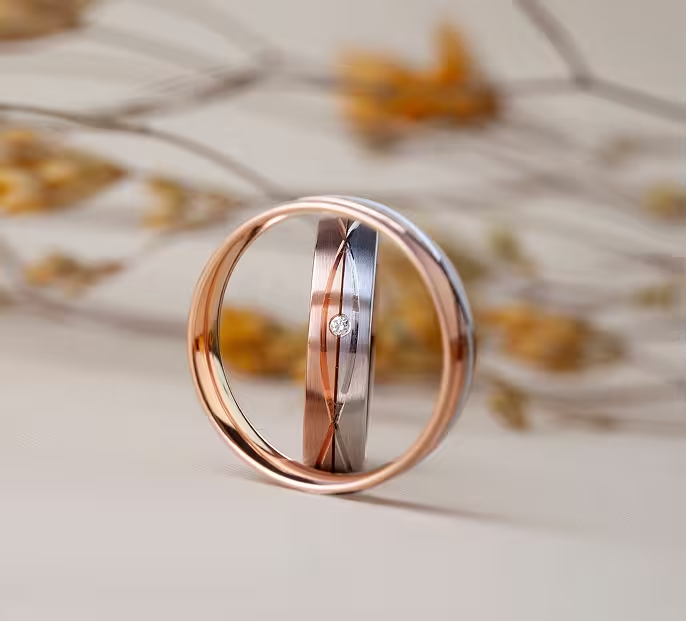
Breuning: a German brand with decades of tradition, bringing a series of diamond wedding bands that combine precise craftsmanship with contemporary design. Models featuring channel-set discreet stones and combined metals are especially appreciated, suitable for both men's and women's wedding bands.
Saint Maurice offers a wide choice of wedding bands with subtle diamond accents, from solitaire settings to half-eternity models. The hallmark of this collection is preserving a classic European character alongside precise execution of fine textural variations, making the wedding band both traditional and contemporary.
Visit Zlatara Andrejević and try them on in store
Choosing a diamond wedding band is a decision that is almost impossible to make from photographs alone. The difference between a pavé and a channel setting, or between a solitaire accent and a half-eternity, becomes clear only when the bands are placed side by side on your hand. Our team at Zlatara Andrejević guides you through all the options without pressure, with three Andrejević family GIA graduate gemologists guaranteeing the quality of every stone.
View the complete collection of diamond wedding bands, explore wider options on the main wedding bands page, or check our locations and book an appointment at a convenient time.