
How to clean and care for gold jewellery at home?
23 October 2026
The gold jewellery we love is usually the piece we wear most often. Therefore, it is natural that over time, traces of everyday life appear on its surface: cosmetics, soaps, creams, natural skin oils, and minor signs of wear.
The gold jewellery we love is usually the piece we wear most often. Therefore, it is natural that over time, traces of everyday life appear on its surface: cosmetics, soaps, creams, natural skin oils, and minor signs of wear.
This does not mean that the gold has lost its quality.
With proper care, it is possible to remove surface dirt and preserve the beauty of your jewellery, but for valuable pieces there is one important rule: not every cleaning method is suitable for every piece of jewellery.
Special care is needed with diamonds, pearls, and gemstones, as well as with certain gold surface finishes.
At Zlatara Andrejević, where jewellery-making knowledge has been passed down through over eight decades of family tradition, jewellery care is viewed as part of its lifespan. It is not just about restoring shine to the surface: it is about preserving the metal, the finish, the construction of the piece, and the security of every stone.
That is why it is useful to know what you can safely do at home, and what should be left to a jeweller.
How to clean gold jewellery at home?
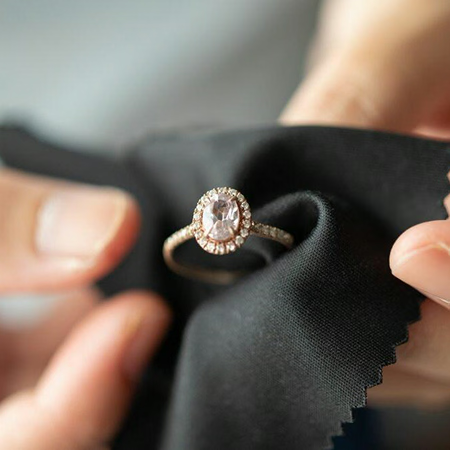
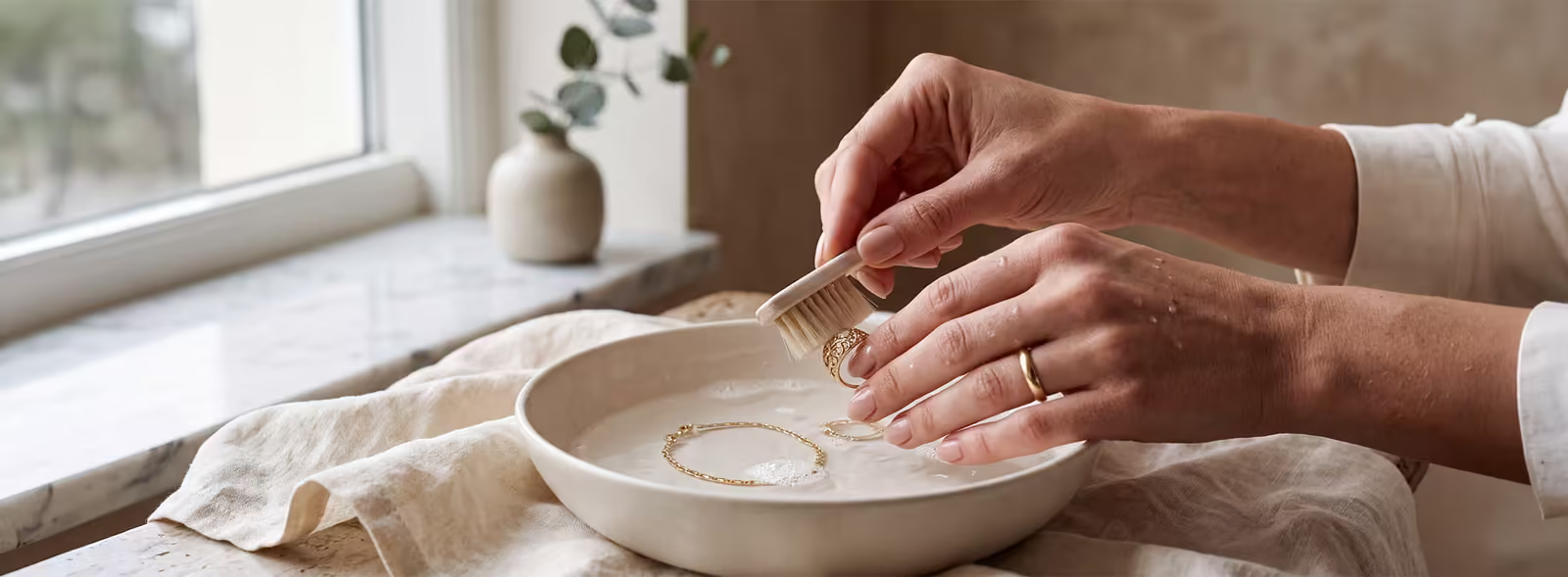
For plain gold jewellery without delicate stones, a gentle approach is usually sufficient: lukewarm water, a small amount of mild washing-up liquid, and a soft brush or cloth.
Leave the jewellery briefly in lukewarm, never hot, water with a small amount of mild washing-up liquid so that surface dirt softens. Accessible parts can be cleaned very gently with a soft brush, then rinsed thoroughly with clean lukewarm water and dried with a soft cloth that will not scratch the surface. Regular, gentle cleaning is also important because it prevents larger deposits of soap, cosmetics, and natural skin oils from building up on the jewellery over time. When jewellery is cared for regularly, such surface impurities can usually be removed using a gentle procedure, without the need for more intensive treatment.
If build-up has already accumulated so much that it cannot be easily removed in the described way, do not try to solve the problem with harsher products or intense scrubbing. It is safer to take the jewellery to a jeweller, as inappropriate cleaning methods can permanently damage the surface of the jewellery, its finish, or its more delicate elements.
Extra caution is needed for jewellery with stones.
Before cleaning, check whether the stone is secure in its setting. If you notice it moving, that a part holding it is deformed, or that there is other damage, do not proceed with home cleaning.
Shine can wait. The security of the stone should not.
Such a piece should first be inspected by a jeweller.
Cleaning and polishing jewellery are not the same thing
It is important to understand this difference.
Cleaning removes deposits and surface dirt from the jewellery. Polishing treats the metal surface itself to restore its appearance and reduce the visibility of certain traces of wear.
If a ring is clean, but you still see fine scratches or a change in the final appearance on its surface, additional washing at home will not solve the problem.
Professional assessment is then required to determine whether the piece needs professional cleaning, polishing, or another form of refinishing.
For fine jewellery, this assessment is precisely what matters: the goal is not to remove every trace at any cost, but to preserve the integrity of the piece.
What should you not use to clean gold?
The internet is full of recipes promising to "restore the old shine" to jewellery in just a few minutes. For valuable jewellery, such experiments are unnecessary.
Avoid strong cleaning products, chlorine and bleaches, abrasive powders and pastes, stiff brushes and sponges, products of unknown composition, and intense surface scrubbing.
Special caution is required with commonly recommended home methods involving bicarbonate of soda, toothpaste, or various acids.
What is harsh enough to quickly remove build-up may at the same time be too harsh for the finish of the jewellery.
For pieces with gemstones, the risk is even greater, as you are caring not only for the gold but for the entire combination of materials.
Can gold be cleaned with toothpaste?
Toothpaste is not a good choice for regular cleaning of fine gold jewellery.
Many toothpastes contain abrasive ingredients designed for cleaning teeth. On a polished jewellery surface, they can contribute to fine marks and scratches.
A gentle approach is safer for home care, whilst more serious cleaning and refinishing should be left to a jeweller.
Can gold be cleaned with bicarbonate of soda?
Bicarbonate of soda often appears in home jewellery cleaning tips, but it is not a universal product for maintaining fine gold.
Its abrasiveness may be unsuitable for certain surfaces and finishes, and for jewellery with stones, the properties of the stone itself must also be taken into account.
With valuable jewellery, there is no reason to experiment with harsher methods when gentler and more controlled care methods exist.
How to clean white gold?
With white gold, it is important to understand that a change in appearance does not necessarily mean the piece is simply "dirty".
Many white gold pieces feature a rhodium coating that gives the surface its characteristic bright, shiny appearance. During wear, this layer can gradually wear away.
More intense scrubbing will not restore the original look; it can only place unnecessary stress on the surface.
When necessary, a jeweller can assess the condition of the piece, professionally prepare the surface, and re-apply rhodium plating.
This is a prime example of why it is important with fine jewellery to distinguish dirt from a change in surface finish.
Read more about the characteristics of different alloys in our guide White, yellow or rose gold: which gold to choose?
How to clean yellow gold?
Plain yellow gold jewellery without delicate stones can usually be cleaned gently with lukewarm water and a mild cleaning agent.
If the jewellery has still lost some of its former lustre after cleaning, the problem may not be dirt.
Years of wear leave traces on the surface of gold.
This is particularly visible on rings and bracelets, which come into contact with far more surfaces during the day than, for instance, a necklace.
If you would like to restore the surface, a jeweller can assess whether professional polishing is required.
How to clean rose gold?
The same principle applies to rose gold: gentler is almost always better.
The distinctive colour of rose gold comes from its alloy composition, in which copper plays an important role. For regular maintenance of a simple piece, aggressive cleaners designed specifically for rose gold are not necessary.
Avoid abrasive methods and harsh chemicals, particularly if the jewellery features a special finish or gemstones.
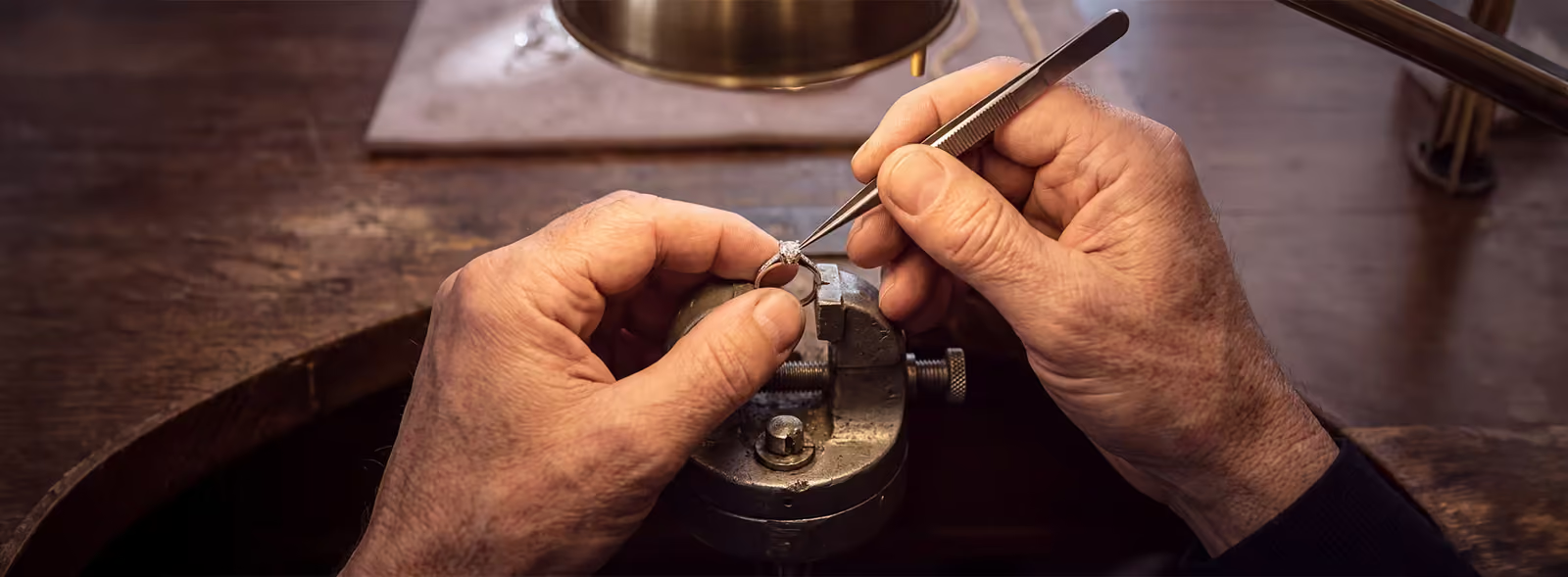
How to clean gold jewellery with diamonds?
A diamond is exceptionally hard. However, diamond jewellery is not just the diamond itself.
There is the gold, the piece's construction and, most importantly, the way the stone is set.
Natural oils from the skin, creams and cosmetics can collect on the surface of a diamond, making the stone appear less brilliant. Proper cleaning can remove these deposits.
Before that, however, check that the stone is held securely.
If you notice any movement or change to the part of the setting holding the diamond, do not proceed with cleaning. The piece should first be inspected by a professional.
For more valuable jewellery, periodic professional checks of the stone setting make sense even when there is no visible issue at first glance.
You can view more designs in the collection of Andrejević diamond jewellery.
Why does a diamond sometimes lose its sparkle?
A diamond may appear less brilliant without anything actually being wrong with the stone itself.
One of the most common reasons is oils and other deposits on its surface.
Diamonds have an affinity for grease, so daily contact with skin, creams and cosmetics can alter the way light passes through the stone and reflects off its facets.
Consequently, even a very high-quality diamond can look different when it is not clean.
Proper maintenance does not "create" a diamond's sparkle, it simply removes what obscures it.
How to clean gold jewellery with gemstones?
When it comes to jewellery with gemstones, there is no single universal cleaning method.
Different gemstones possess different physical and chemical properties, and certain stones may also be treated. A method that is safe for one stone might be completely unsuitable for another.
Heat, certain chemicals, ultrasonic cleaning or even prolonged soaking can pose a risk, depending on the type and any potential treatment of the stone, as well as how it is set in the jewellery.
Therefore, if you are not certain which stone you have or how it has been treated, avoid experimenting with home cleaning methods. For valuable gemstone jewellery, it is recommended that the piece be inspected by an expert who can assess both the stone and its setting, and then determine the appropriate care method.
At Zlatara Andrejević, such an assessment relies on both gemmological and jewellery expertise. Andreja Andrejević is a qualified gemmologist and a specialist in master diamond setting, whilst Aleksandar Andrejević is a qualified gemmologist and jewellery designer. It is precisely this combination of understanding the stone and how it is set that is essential for the safe maintenance of gemstone jewellery.
A simple rule therefore applies to gemstones: when you are unsure of what you have in front of you, a professional assessment is safer than a universal home remedy.
How to clean pearl jewellery?
Pearls require an entirely different kind of care.
Their surface is more delicate, which is why pearl jewellery should not be treated in the same way as a diamond or a simple gold chain.
After wearing, you can gently wipe pearls with a clean, soft cloth to remove any traces from the surface.
Direct contact with perfumes, hairspray and other cosmetic products should be particularly avoided.
One elegant and simple rule is easy enough to remember:
Pearls are the last thing to put on, and the first thing to take off.
For a more thorough cleaning of pearl jewellery, it is best to consult an expert, especially when pearls are strung or combined with other materials.
Should gold jewellery be removed while showering?
Occasional contact between gold and ordinary water does not mean the jewellery will automatically be damaged.
Even so, showering regularly whilst wearing fine jewellery is not the best habit.
Soap, shampoo and cosmetic products can leave deposits on gold and stones. Removing jewellery before showering also reduces unnecessary exposure to chemicals, knocks and mechanical wear.
For jewellery you wish to wear for years to come, small habits often make the biggest difference.
Should you take off gold jewellery in a swimming pool?
Yes. It is advisable to remove fine gold jewellery before entering a pool.
Chlorine and other chemicals are not things valuable jewellery should be unnecessarily exposed to.
The same rule applies when using strong household cleaning products. It is best to remove rings and bracelets on those occasions.
Should you sleep wearing gold jewellery?
A simple piece of jewellery may not suffer visible damage from a single night, but sleeping with jewellery is not an ideal daily habit.
Delicate chains can tangle, certain earrings can be subjected to pressure, whilst rings and gemstone jewellery come into unnecessary contact with fabrics and other surfaces.
If you want fine jewellery to maintain its condition for as long as possible, removing it before sleep is a simple preventive habit.
Perfume, cream and jewellery: in what order?
When it comes to jewellery, there is a simple rule worth adopting:
cosmetics first, jewellery last.
Apply perfume, cream, makeup and hair products before putting on your jewellery.
This minimises direct build-up of products on the surface of gold and stones.
This rule is particularly important for pearls and more delicate gemstones.
How to store gold jewellery correctly?
Caring for your jewellery does not end when you take it off.
It is best to store pieces so they touch each other as little as possible. This reduces unnecessary friction and the chance of scratches.
Particular caution is needed with diamonds.
Due to its exceptional hardness, a diamond can scratch other pieces of jewellery, and even another diamond. It is therefore best to store diamond jewellery separately.
Store chains so they do not tangle, and protect more delicate pieces from friction.
A box with individual compartments or separate soft pouches can be a simple, elegant solution.
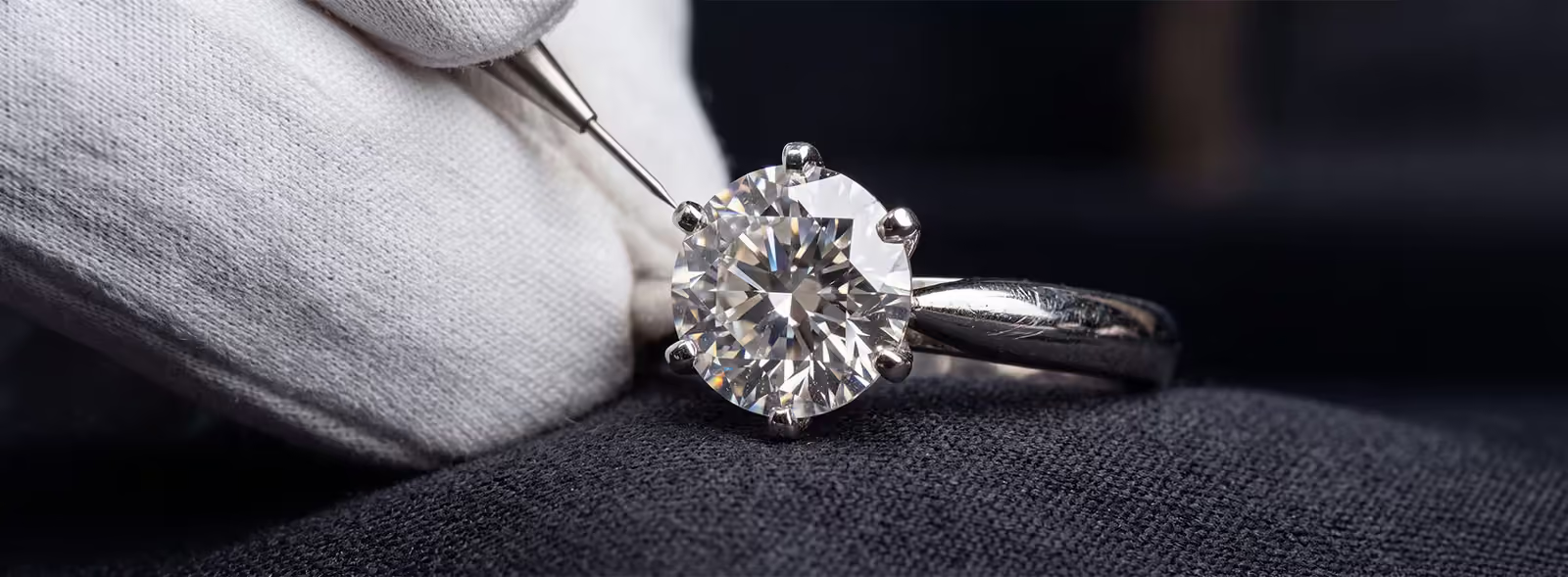
When should gold jewellery be taken to a jeweller?
Home cleaning removes surface impurities. A professional inspection answers a far more important question: what condition is the piece itself in?
Consult a jeweller if a stone is loose, if you notice a change or damage to its setting, if the clasp no longer works properly, if a chain or bracelet has a damaged link, or if a ring has become misshapen.
Professional care is also needed when white gold requires its finish restored, when you want professional polishing, or when you have a valuable piece with diamonds or gemstones and are unsure how to care for it safely.
For jewellery worn daily, occasional inspections can spot a minor change before it develops into a more serious issue.
How often should gold jewellery be cleaned?
There is no single timeframe that suits every piece, but regular maintenance is far better than waiting for stubborn deposits to build up on the jewellery.
A ring worn every day lives a completely different life to a necklace worn only a few times a year. Soap, creams, cosmetics and natural oils from the skin can gradually build up on the surface of the jewellery and around its detailing.
The frequency of cleaning should therefore be tailored to how and how often a piece is worn. When you notice surface deposits beginning to form on the jewellery, clean it using a gentle method recommended for that type of piece before dirt accumulates significantly.
If deposits can no longer be easily removed in this way, do not resort to aggressive home cleaning methods. We recommend taking the jewellery to a jeweller, who can assess the appropriate cleaning method without risking unnecessary permanent damage.
For jewellery with diamonds, gemstones, pearls or special finishes, professional assessment is particularly important, as the cleaning method must be tailored not only to the gold, but to all other elements of the piece.
When does jewellery care become a job for a professional?
With fine jewellery, professional maintenance is not just a matter of shine.
It requires an understanding of how the piece was crafted, how the stone is set, the condition of the metal, and which type of intervention is right for that specific piece of jewellery.
This is especially important with diamond jewellery.
At Zlatara Andrejević, different areas of jewellery-making and gemmological expertise come together within the family: Kosta Andrejević is a master craftsman of exclusive jewellery, a designer and a certified diamond expert; Andreja Andrejević specializes in master diamond setting and is a qualified gemmologist, whilst Aleksandar Andrejević is a qualified gemmologist and jewellery designer.
During an inspection of the jewellery, this means looking beyond what is visible on the surface.
With a diamond ring, for example, both the stone and the security of its setting are important. With white gold, surface dirt must be distinguished from wear of the outer layer. With gemstone jewellery, the cleaning method must be tailored to the characteristics of the specific stone.
Professional maintenance of fine jewellery is therefore not an attempt to erase every trace of time. Its goal is to preserve what makes the piece valuable.
Fine jewellery should be worn
Minor traces of time are part of jewellery that is truly enjoyed and worn.
A ring worn on your hand for years will not look forever like the day it left the workshop. And it doesn't need to.
There is a certain beauty in jewellery becoming part of the life of the person who wears it.
However, there is a difference between natural traces of time and damage that can be prevented.
Take off your jewellery before going into swimming pools or working with harsh chemicals. Put it on only after applying cosmetics. Store pieces separately. Do not attempt to fix serious changes with aggressive home methods.
And when you are unsure, leave it in the hands of those who understand how it was made.
The collection of Andrejević gold jewellery includes rings, earrings, necklaces, bracelets and pendants, as well as pieces with diamonds and gemstones.
Frequently asked questions about cleaning and maintaining gold jewellery
What is best for cleaning gold at home?
For simple gold jewellery without delicate stones, the safest approach is a gentle one using lukewarm water, a small amount of mild washing-up liquid and a soft brush or cloth. For jewellery with stones, the cleaning method should be tailored to the specific stone and the piece's construction.
Can I clean gold with toothpaste?
Toothpaste is not recommended for regular cleaning of fine jewellery as it can contain abrasive ingredients that may leave fine scratches on polished surfaces.
Does baking soda clean gold?
Although it frequently appears in home-care advice, baking soda is not a universally safe agent for fine jewellery. For valuable gold, special finishes and stone-set jewellery, it is better to use a gentler method.
Why does white gold change colour?
Many white gold pieces feature a rhodium finish. As it gradually wears down, the appearance of the surface can change. Professional maintenance and, when required, re-rhodium plating can restore the original finish.
How do you restore shine to a diamond?
If a diamond appears less brilliant due to oils and surface impurities, proper cleaning can help. Before cleaning, check whether the stone is securely set.
Can I clean all gemstones in the same way?
No. Different gemstones have different physical and chemical properties, and certain stones may also be treated. The cleaning method should therefore be tailored to the specific stone.
Should gold jewellery be removed in swimming pools?
Yes. It is recommended to remove fine gold jewellery before entering a swimming pool to avoid unnecessary exposure to chlorine and other chemicals.
When should jewellery be taken to a jeweller?
When a stone is loose, a clasp does not work properly, a ring is misshapen, or there is damage to a link or setting, or when the jewellery requires polishing, rhodium plating or other professional care, it is time for a professional inspection.